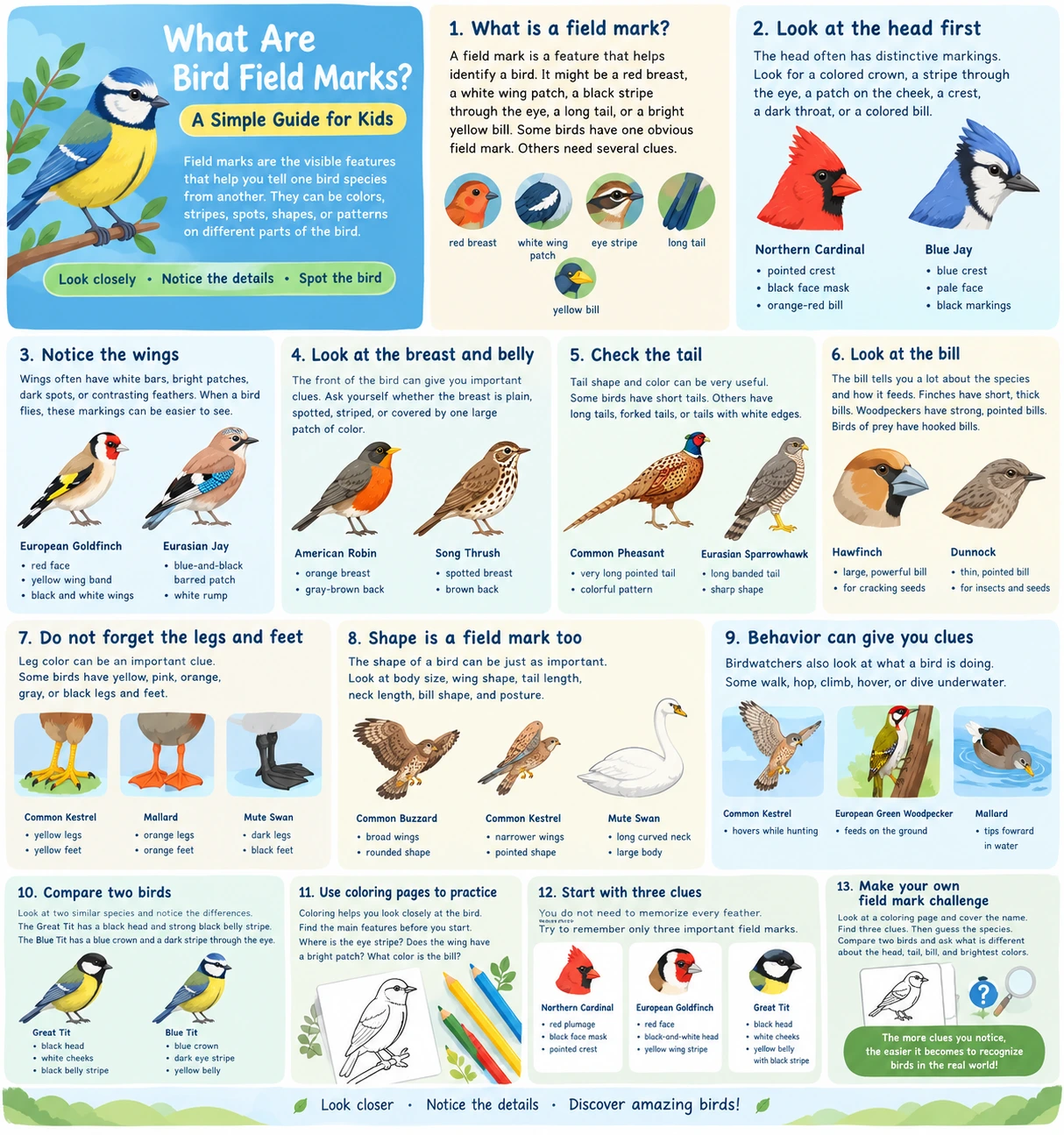
Birds can look confusing at first. Two birds may both be brown, both may be small, or both may have yellow on their bodies. Birdwatchers solve this problem by looking for special details called field marks. Field marks are the visible features that help you tell one bird species from another. They can be colors, stripes, spots, shapes, or patterns on different parts of the bird. Once you learn to notice them, bird identification becomes much easier.
What is a field mark?
A field mark is a feature that helps identify a bird. It might be a red breast, a white wing patch, a black stripe through the eye, a long tail, or a bright yellow bill. Some birds have one very obvious field mark. Others need several clues before you can be sure which species you are looking at.
For example, a Northern Cardinal is easy to recognize because of its pointed crest, strong orange-red bill, and bright red plumage in the male. A Great Tit has a different set of field marks: a black head, white cheeks, and a dark stripe down the yellow breast.
Look at the head first
The head is one of the best places to start. Many birds have distinctive markings around the face. Look for a colored crown, a stripe through the eye, a patch on the cheek, a crest, a dark throat, or a colored bill.
A Eurasian Tree Sparrow, for example, has a chestnut crown and a black spot on each white cheek. A Blue Jay has a blue crest, pale face, and black markings around the neck and head. These features can be much easier to remember than the bird’s overall color.
Notice the wings
Wings often contain some of the most useful field marks. Birds may have white wing bars, bright patches, dark spots, or contrasting feathers.
The European Goldfinch has a bright yellow band across its dark wings. The Eurasian Jay has a vivid blue-and-black barred patch on the wing. A Blue Jay also has bold blue, black, and white patterns across the wings and tail. When a bird flies, these markings can sometimes be easier to see than when it is sitting still.
Look at the breast and belly
The front of the bird can give you important clues. Ask yourself whether the breast is plain, spotted, striped, or covered by one large patch of color.
An American Robin has a warm orange breast. A Song Thrush has a pale breast covered with dark spots. A Great Tit has a yellow belly with a dark stripe running down the center. These patterns are often some of the first things you notice.
Check the tail
Tail shape and color can be very useful. Some birds have short tails. Others have long tails, forked tails, or tails with white edges.
A Common Pheasant has an extremely long pointed tail. A Eurasian Sparrowhawk has a long banded tail that helps it turn quickly between trees. A Common Kestrel also has a long tail, but its shape and flight style are different. Even when the bird is far away, tail shape can help narrow down the possibilities.
Look at the bill
The bill can tell you a lot about both the species and the way the bird feeds. Finches often have short, thick bills for cracking seeds. Woodpeckers have strong, pointed bills for working on wood. Birds of prey have hooked bills. Ducks have broad, flattened bills.
A Hawfinch has an especially large and powerful bill, while a Dunnock has a much thinner pointed bill. Even if two birds have similar colors, their bills may be completely different.
Do not forget the legs and feet
Leg color is sometimes an important identification clue. Some birds have yellow legs, others pink, orange, gray, or black.
A Common Kestrel has bright yellow legs and feet. A Mallard has orange legs. A Mute Swan has dark gray to black legs and feet. These details may not always be easy to see, but they can help confirm an identification.
Shape is a field mark too
Field marks are not only about color. The shape of a bird can be just as important. Look at body size, wing shape, tail length, neck length, bill shape, and posture.
A Common Buzzard has broad rounded wings. A Common Kestrel has narrower pointed wings. A Mute Swan has a very long curved neck. A woodpecker has a strong bill and a stiff tail. Learning these shapes can help identify birds even when the colors are difficult to see.
Behavior can give you clues
Birdwatchers also look at what a bird is doing. Some birds walk on the ground. Some hop. Some climb tree trunks. Some hover. Some dive underwater.
A Common Kestrel often hovers while hunting. A European Green Woodpecker spends a lot of time feeding on the ground. A Mallard often tips forward in the water while feeding. Behavior is not technically a plumage mark, but it is still a very useful identification clue.
Try comparing two birds
A good way to learn field marks is to compare two similar species. Look at a Great Tit and a Eurasian Blue Tit. Both are small garden birds with yellow underparts.
The Great Tit has a black head and strong black belly stripe. The Blue Tit has a blue crown and a dark stripe through the eye. Once you compare the birds directly, the differences become much easier to remember.
Use coloring pages to practice
Coloring is a simple way to learn field marks because it makes you look closely at the bird. Before you start coloring, find the main identification features. Where is the eye stripe? Does the wing have a bright patch? What color is the bill? Is the breast spotted or plain?
Then use the natural color guide to fill in those features. When you later see the real bird outside, the same markings may feel familiar.
Start with three clues
You do not need to memorize every feather. For each bird, try to remember only three important field marks.
For a Northern Cardinal, remember red plumage, a black face mask, and a pointed crest. For a European Goldfinch, remember the red face, black-and-white head, and yellow wing stripe. For a Great Tit, remember the black head, white cheeks, and yellow belly with a black stripe.
Three good clues are often enough to make a bird much easier to recognize.
Make your own field mark challenge
Choose a bird coloring page and cover the bird’s name. Look at the illustration and try to find three clues. Then guess the species.
You can also compare two coloring pages and ask what is different about the head, which bird has the longer tail, which has the thicker bill, and where the brightest colors are. This turns coloring into a simple bird identification game.
Field marks make birdwatching easier
At first, birds can seem like a blur of feathers and colors. But once you start looking for field marks, you begin to see patterns.
A white cheek, a yellow wing stripe, a red crown, a hooked bill, or a spotted breast can all be useful clues. The more clues you notice while coloring and watching birds, the easier it becomes to recognize species in the real world.