
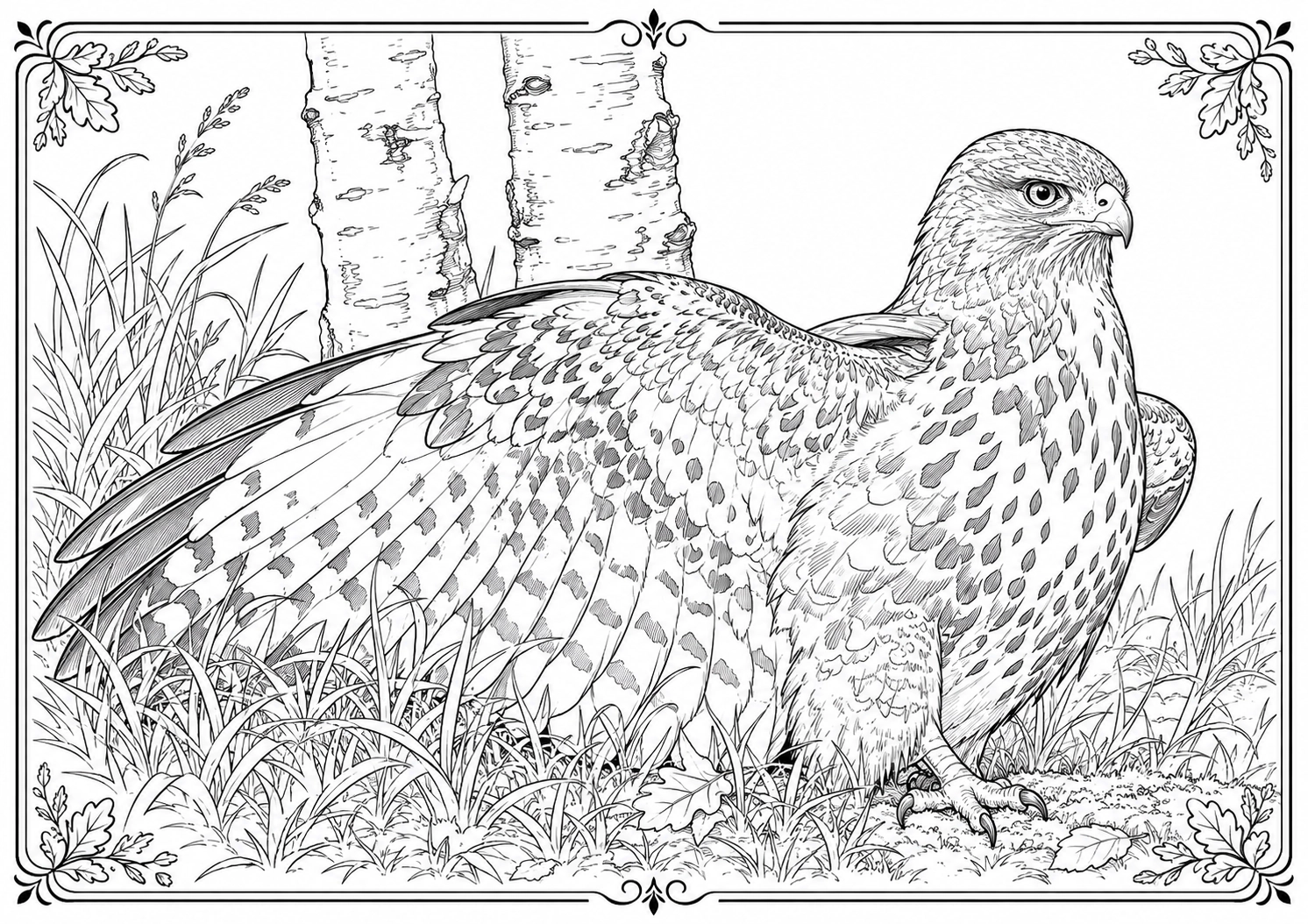
- Scientific name: Buteo buteo
- Group: Birds of Prey
This printable Common Buzzard coloring page is inspired by the bird’s powerful body, broad wings, hooked bill, strong feet, and rounded tail. The clear outlines make it suitable for colored pencils, crayons, markers, or paint.
Common Buzzards vary greatly in color, so there is no single correct way to complete the picture. You can use warm brown and cream shades for a typical bird, choose the much paler plumage of a light individual, or create your own pattern.
Color guide
- Head and back: medium to dark brown
- Breast and belly: cream, buff, or brown with darker streaks and patches
- Wings: brown with darker flight feathers and pale markings
- Underwings: pale cream or gray-brown with dark edges and bars
- Tail: gray-brown or reddish brown with narrow dark bands
- Bill: dark gray or black with a yellow base
- Eyes: brown
- Cere: yellow
- Legs and feet: yellow
- Claws: black
Common Buzzards are extremely variable. Some individuals are almost uniformly dark brown, while others have a pale head, light underparts, and only scattered brown markings.
How to recognize a Common Buzzard
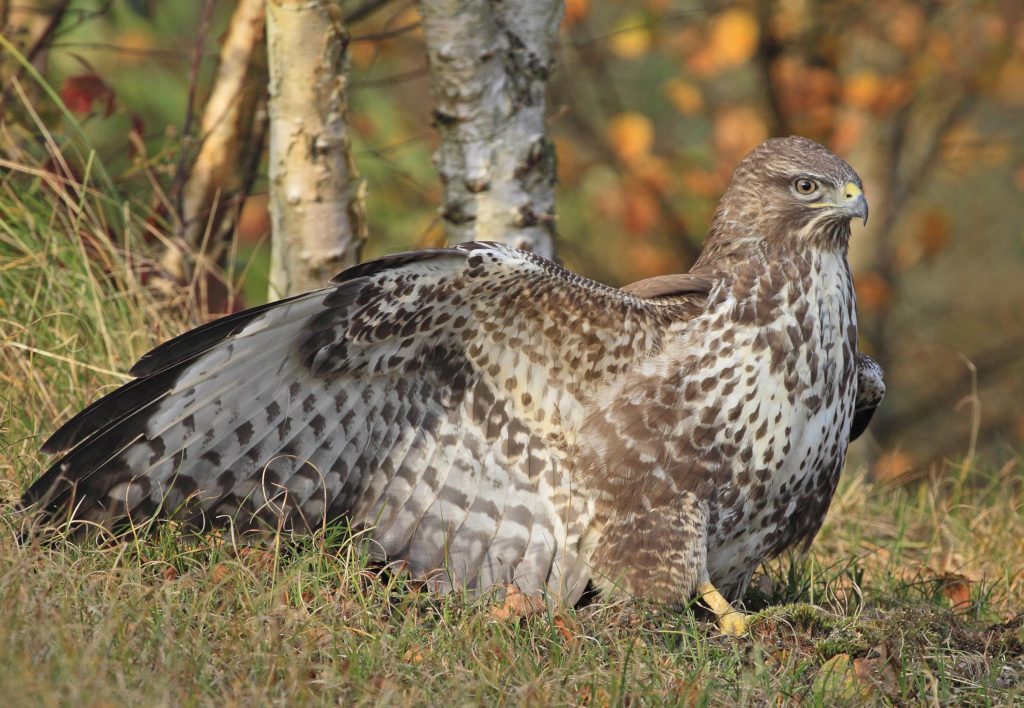
The Common Buzzard is a medium-to-large bird of prey with a heavy body, broad rounded wings, a short neck, and a relatively short, rounded tail. When soaring, it often holds its wings in a shallow V and circles slowly on rising warm air.
Its plumage can range from very pale cream to almost black, which sometimes makes identification difficult. Most birds are mottled brown and pale underneath, with darker areas around the belly and along the edges of the wings.
A perched buzzard often looks broad-chested and slightly hunched. Its call is a thin, descending mewing sound that can resemble the voice of a cat.
Where it lives
Common Buzzards occur across much of Europe and parts of Asia. They live in landscapes that combine woodland or groups of mature trees with open areas where they can search for prey.
Typical habitats include farmland, forest edges, grassland, moorland, valleys, and open countryside. They also occur near roads, where they may sit on fence posts, trees, or utility poles while watching the ground.
Buzzards usually build their nests high in trees. Some populations remain in the same area throughout the year, while others migrate or make shorter seasonal movements.
What it eats
Common Buzzards hunt a wide variety of prey. Their diet includes small mammals, birds, reptiles, amphibians, insects, and earthworms.
Voles and other small rodents are especially important in many areas. Buzzards may watch for prey from a perch or circle above open ground before descending.
They also eat carrion and may be seen feeding on animals killed on roads or in fields. Their flexible diet helps them survive in many different habitats.
Interesting facts
- The Common Buzzard is one of the most widespread birds of prey in Europe and is now the most common and widespread raptor in the United Kingdom.
- Its plumage is unusually variable. Pale and dark Common Buzzards may look so different that they appear to belong to separate species.
- Buzzards use rising columns of warm air called thermals to gain height while using very little energy.
- Their mewing call is often heard when several birds circle together high above the countryside.
- A Common Buzzard may remain almost motionless on a fence post or tree for long periods while watching the ground for movement.
- Pairs are territorial during the breeding season and may perform circling, diving, and calling displays above their nesting area.