
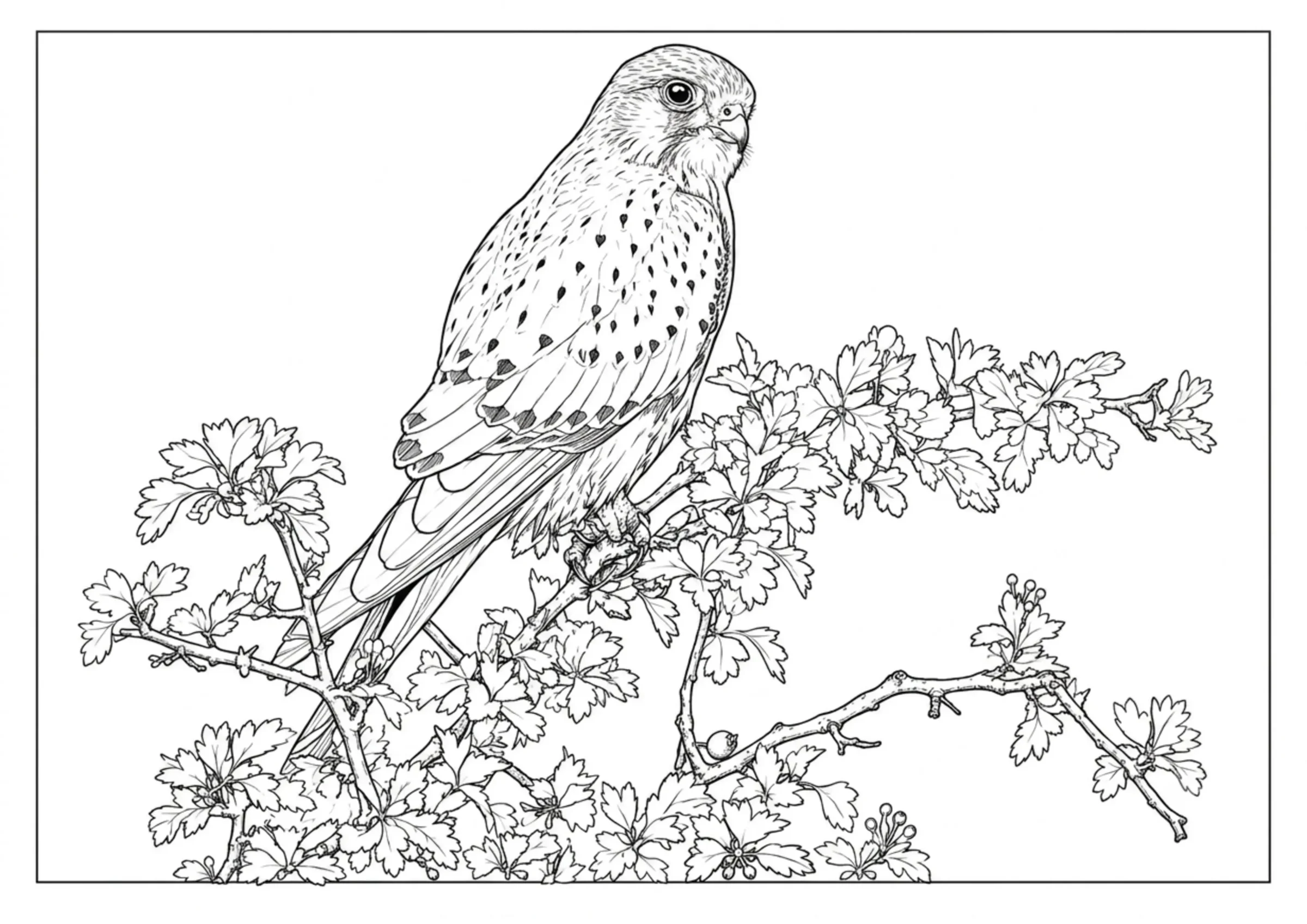
- Scientific name: Falco tinnunculus
- Group: Birds of Prey
This printable Common Kestrel coloring page is based on the bird’s slim body, pointed wings, long tail, and compact falcon shape.
The Common Kestrel is one of Europe’s most familiar birds of prey. It is often seen hovering over fields, roadsides, and open countryside while searching for small animals below.
Use the natural color guide for a realistic result, or choose your own colors and create a more imaginative version.
Color guide
Adult male:
- Head: blue-gray
- Back: warm reddish-brown with small dark spots
- Wings: reddish-brown above with darker markings
- Underparts: pale cream or buff with dark spots
- Tail: blue-gray with a broad black band near the tip
- Bill: dark gray or black with a yellow base
- Eyes: dark brown
- Eye ring and cere: yellow
- Legs and feet: bright yellow
- Claws: black
Adult female:
- Head and back: warm brown
- Upperparts: brown with dark bars and spots
- Underparts: pale buff with heavier dark streaking
- Tail: brown with several dark horizontal bands
Young birds resemble females and are generally brown and strongly patterned.
How to recognize a Common Kestrel
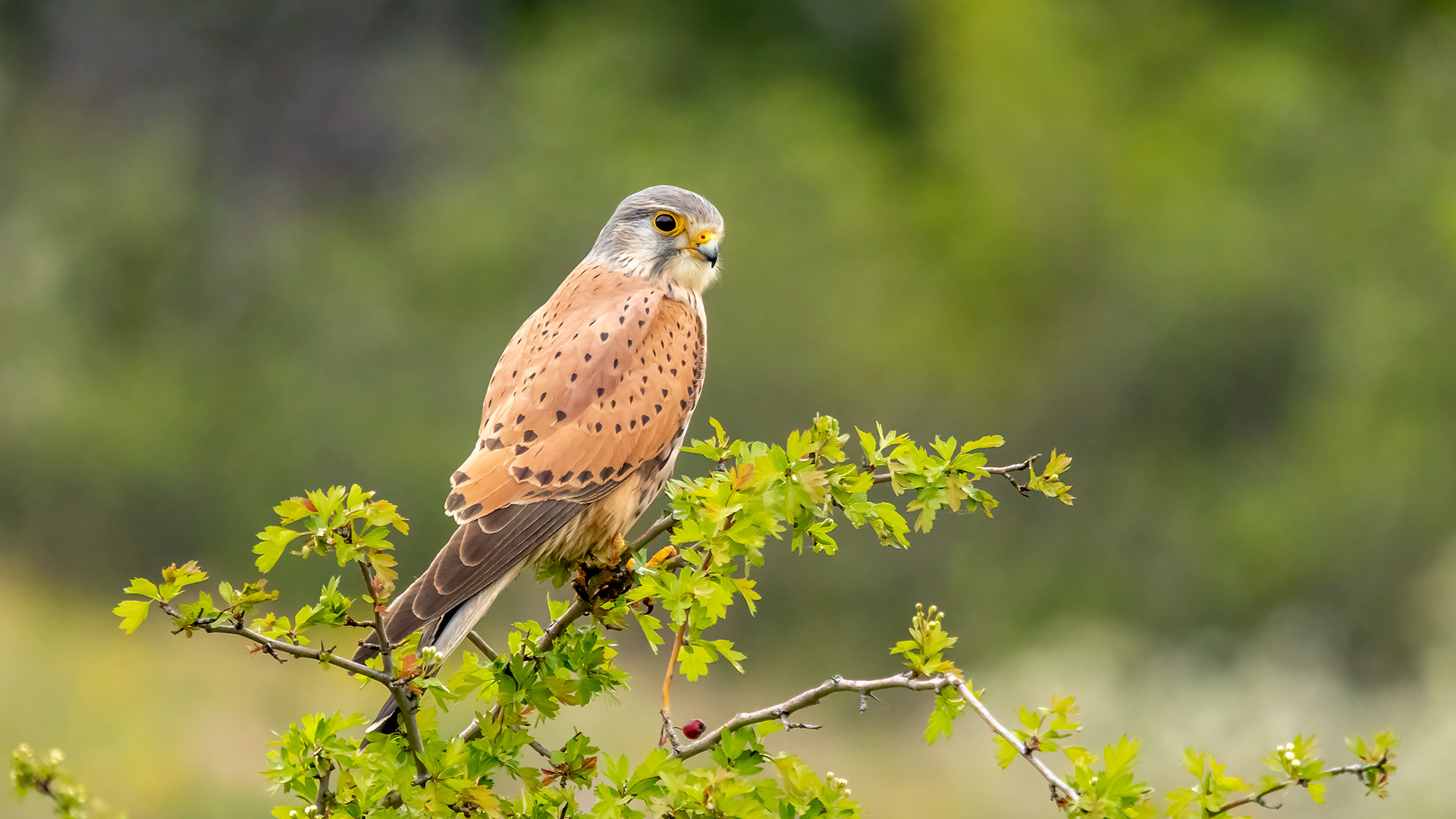
The Common Kestrel is a small falcon with pointed wings and a relatively long tail.
One of its most distinctive behaviors is hovering. The bird can remain almost stationary in the air by rapidly beating its wings while facing into the wind, watching the ground below for prey.
Males and females look different. Adult males have a gray head and gray tail, while females are more uniformly brown and heavily barred.
In flight, the kestrel’s narrow pointed wings help distinguish it from broader-winged birds of prey such as the Common Buzzard.
Where it lives
Common Kestrels are widespread across Europe, much of Asia, and parts of Africa.
They prefer open landscapes where they can hunt easily, including farmland, grassland, heathland, meadows, road verges, cliffs, and the edges of towns and villages.
They also adapt well to cities and may nest on buildings, towers, church roofs, bridges, and other high structures.
Unlike many birds, kestrels do not build elaborate nests. They often use ledges, cavities, old nests of other birds, or suitable spaces in buildings.
What it eats
Common Kestrels feed mainly on small mammals.
Voles are particularly important prey in many areas, but kestrels also catch mice, shrews, small birds, lizards, insects, and other small animals.
They often hunt by hovering, but they can also watch from a fence post, tree, pole, or other elevated perch before dropping quickly onto prey.
Their excellent eyesight helps them detect movement in grass from a considerable distance.
Interesting facts
- The Common Kestrel belongs to the falcon family, Falconidae.
- Its hovering flight is so characteristic that it is sometimes called “wind-hovering.”
- Kestrels can see ultraviolet light. This may help them locate trails left by small mammals such as voles.
- Adult males and females have noticeably different plumage, making the species a good example of sexual dimorphism.
- Common Kestrels are highly adaptable and can live in both rural landscapes and large cities.
- They often use human-made structures as nesting sites, including towers, barns, bridges, and tall buildings.
- Although they are birds of prey, kestrels are much smaller and lighter than large raptors such as buzzards and eagles.