- Scientific name: Garrulus glandarius
- Group: Woodland Birds
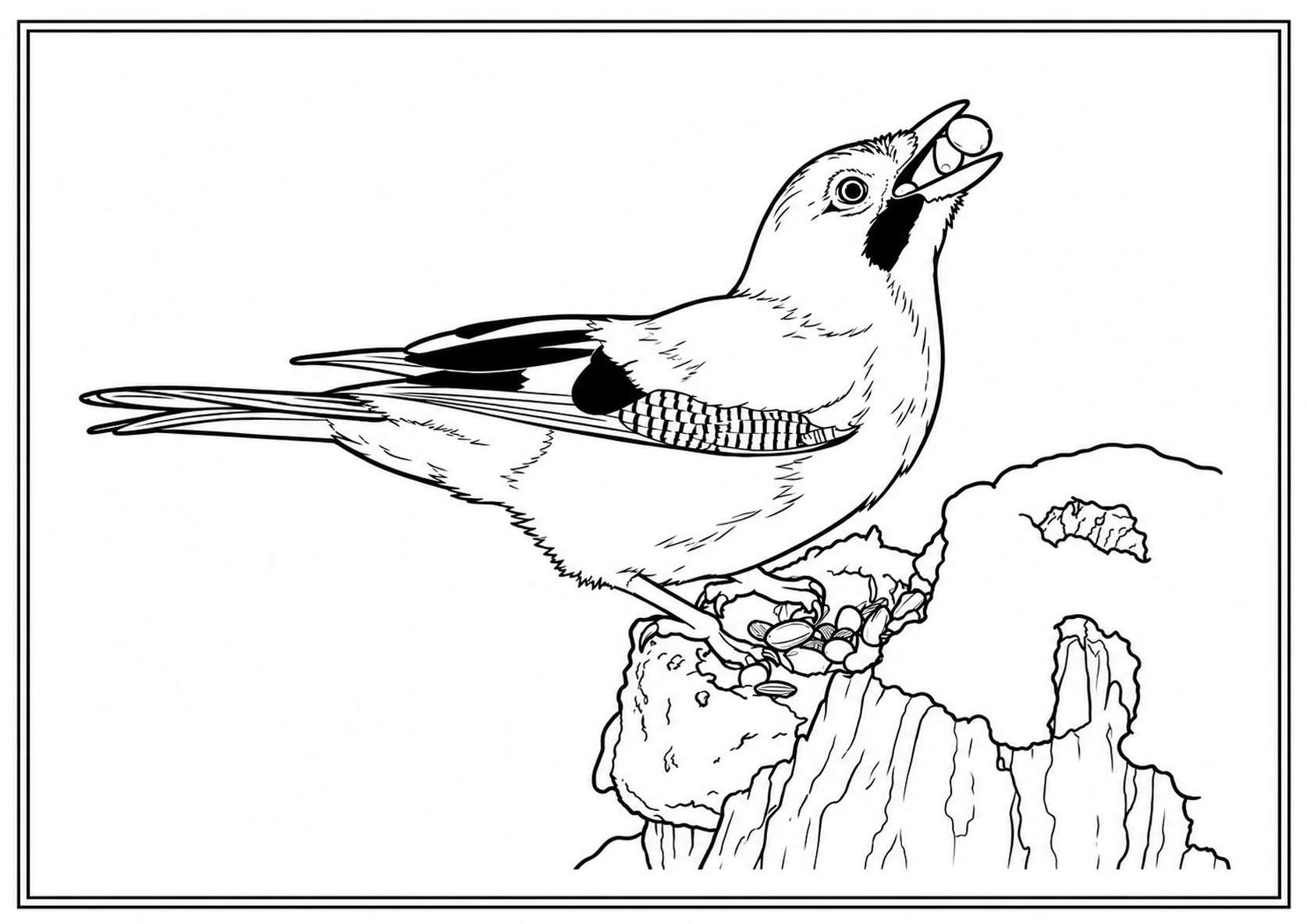
This printable Eurasian Jay coloring page is inspired by the bird’s sturdy body, rounded wings, strong bill, and distinctive blue-and-black wing patch. The clean outlines make the illustration suitable for colored pencils, crayons, markers, or paint.
Use warm pinkish-brown, black, white, blue, and gray to recreate the natural plumage of an adult Eurasian Jay. The bright blue barred feathers on the wings are especially important—they are one of the bird’s most recognizable features.
Color guide
- Head and body: warm pinkish-brown or buff
- Forehead: pale with dark streaks
- Moustache stripe: black
- Wings: black and white with a bright blue barred patch
- Rump: white
- Tail: black
- Bill: dark gray or black
- Eyes: pale blue-gray or light brown
- Legs and feet: gray-brown
- The blue wing patch is made up of small feathers marked with alternating blue, black, and white bars.
How to recognize a Eurasian Jay
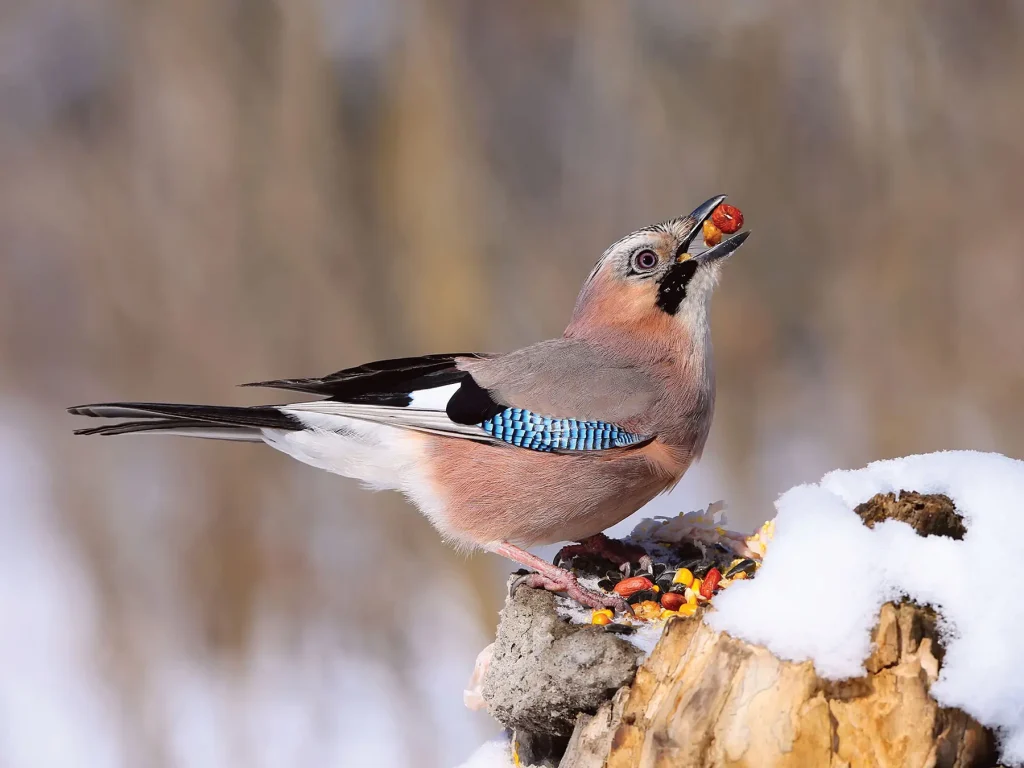
The Eurasian Jay is a medium-sized member of the crow family with a strong bill, broad wings, and a relatively long tail. Its body is mostly pinkish-brown, while the face shows a bold black moustache-like stripe.
The most distinctive feature is the bright blue-and-black barred patch on the wing. In flight, the white rump and black tail are also easy to see.
Eurasian Jays are often secretive in woodland, but they become much easier to notice when they give their loud, harsh alarm call. They may also imitate the calls of other birds.
Where it lives
Eurasian Jays live across much of Europe, North Africa, and large parts of Asia. They are strongly associated with woodland, especially deciduous and mixed forests with oak trees.
They are also found in parks, large gardens, orchards, and wooded suburban areas. Although they often remain hidden among trees, they may visit more open ground when searching for food.
Most Eurasian Jays are resident, but some populations make seasonal movements when food becomes scarce.
What it eats
Eurasian Jays eat a wide variety of foods, including insects, seeds, nuts, fruit, berries, eggs, and small animals.
Acorns are especially important. Jays collect them in autumn and hide them in the ground for later use. They do not recover every stored acorn, and some of the forgotten ones can grow into new oak trees.
They may also visit gardens and feeding stations for peanuts and other high-energy foods.
Interesting facts
- Eurasian Jays belong to the crow family, Corvidae, which also includes crows, ravens, magpies, and jackdaws.
- They are famous for storing acorns and can remember the locations of many hidden food caches.
- By burying acorns and forgetting some of them, Eurasian Jays help spread oak trees and contribute to forest regeneration.
- Their bright blue wing feathers do not contain blue pigment. The blue appearance is created mainly by the microscopic structure of the feathers.
- Eurasian Jays are skilled mimics and can imitate the calls of other birds, including birds of prey.
- Despite their colorful plumage, they can be surprisingly difficult to spot when sitting quietly among branches and leaves.