
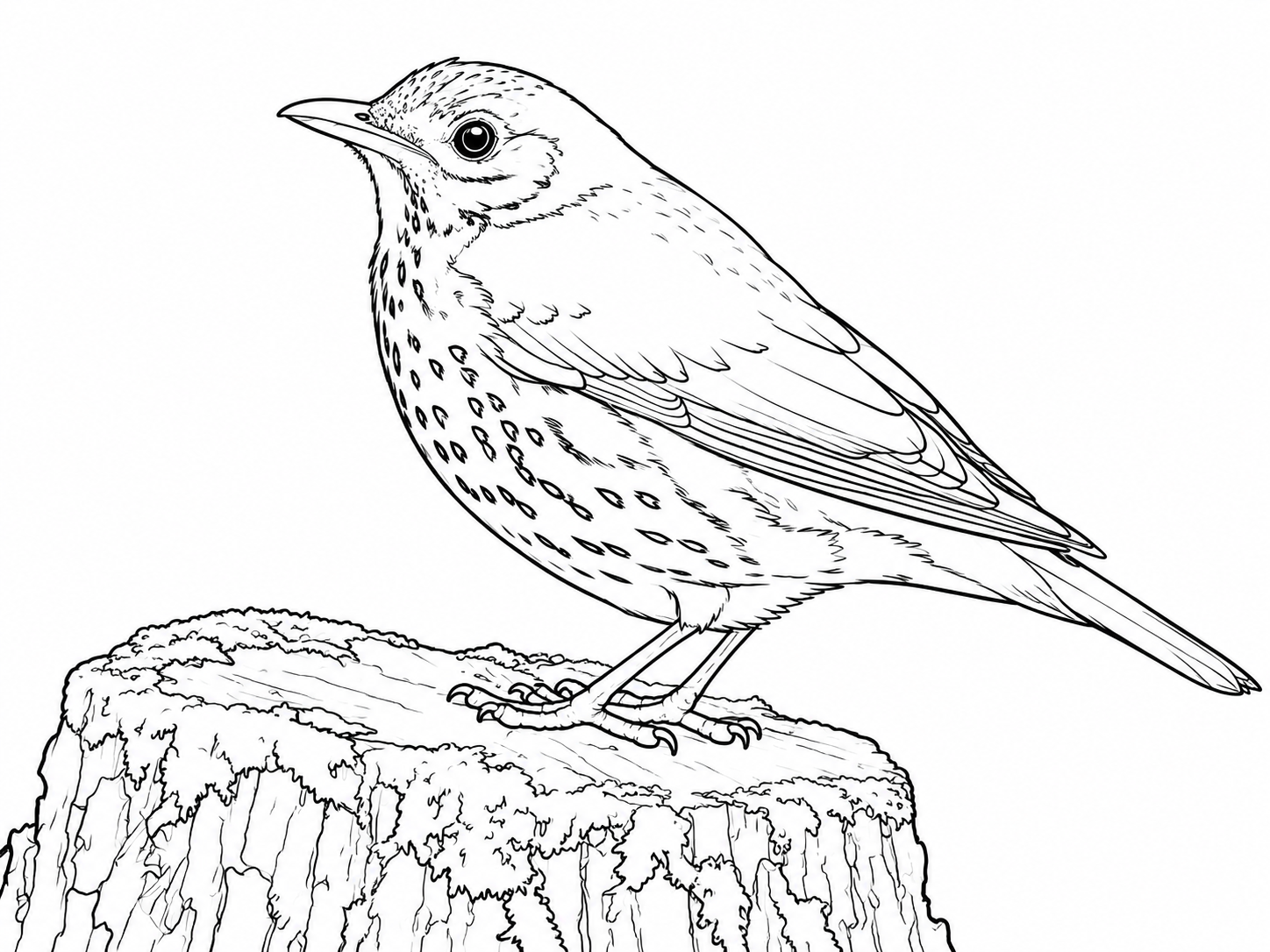
- Scientific name: Turdus philomelos
- Group: Garden Birds
This printable Song Thrush coloring page is inspired by the bird’s rounded body, upright posture, slender bill, and neatly spotted underparts. The clean outlines make it suitable for colored pencils, crayons, markers, or paint.
Use warm brown, cream, and buff tones to recreate the natural appearance of a real Song Thrush. The most important feature to notice is the pattern of dark spots across the pale breast and belly.
Color guide
- Head and back: warm brown
- Wings: brown with slightly darker flight feathers
- Rump and tail: brown
- Face: pale buff with a dark eye
- Throat and breast: cream or buff with dark brown spots
- Belly: pale cream with fewer spots toward the lower belly
- Bill: brown, horn-colored, or dark gray
- Eyes: dark brown or black
- Legs and feet: pinkish brown or pale flesh-brown
Young birds are usually similar to adults but may show buff edges on the upper feathers and a slightly softer overall pattern.
How to recognize a Song Thrush
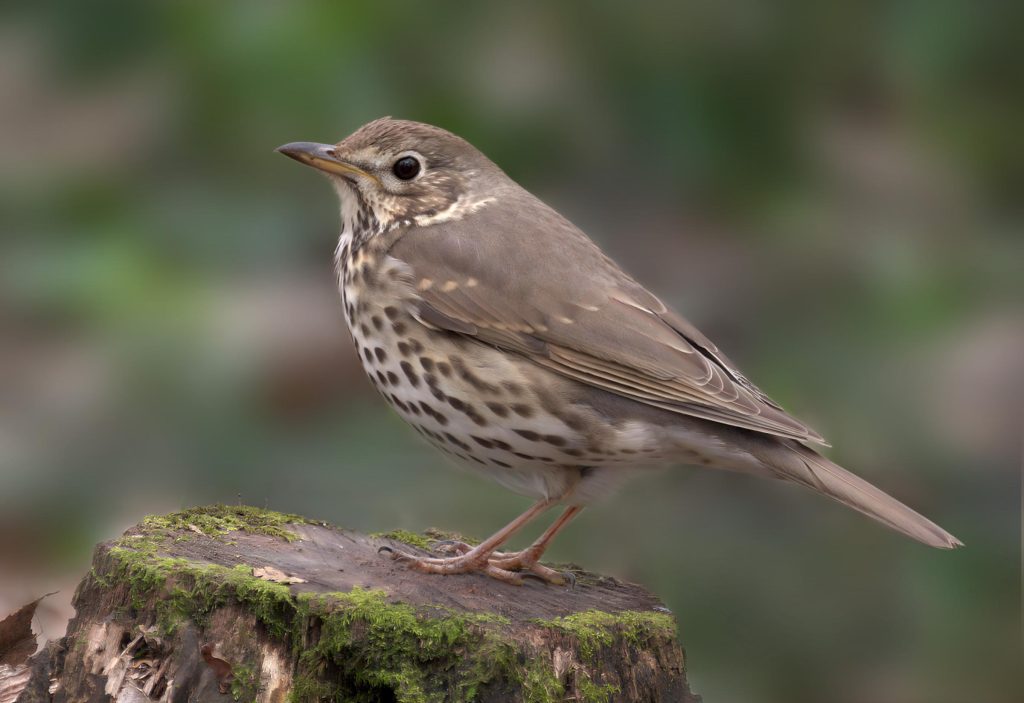
The Song Thrush is a medium-sized thrush with a rounded body, fairly long legs, a straight pointed bill, and a warm brown back. Its most recognizable feature is the pale underside covered with dark, arrow-shaped or rounded spots.
It is often confused with the Mistle Thrush, but the Song Thrush is smaller and more compact, with warmer brown upperparts and more distinct spotting below. It also has a more delicate shape and usually moves with quick hops on the ground.
Its song is one of the best clues to its identity. A Song Thrush often repeats short musical phrases several times before moving on to the next one, creating a rich, varied, and recognizable performance.
Where it lives
Song Thrushes live in woodland edges, hedgerows, parks, gardens, orchards, scrub, and farmland with plenty of bushes and trees. They like places that combine cover for nesting with open ground for feeding.
They are widespread across much of Europe and also occur in parts of Asia. In many areas they are familiar garden birds, especially where lawns, leaf litter, and shrubs provide good feeding and nesting conditions.
Some populations remain in the same region throughout the year, while others migrate or move south and west during colder months.
What it eats
Song Thrushes eat earthworms, insects, beetles, spiders, snails, and other small invertebrates. They often feed on the ground, searching lawns, damp soil, and leaf litter.
They also eat berries and soft fruit, especially in autumn and winter. Their diet changes with the seasons, allowing them to take advantage of whatever food is most available.
Song Thrushes are well known for breaking snail shells against a stone or other hard surface. These “anvils” are a classic sign that a Song Thrush has been feeding nearby.
Interesting facts
The Song Thrush belongs to the thrush family.
Its song often includes repeated phrases, unlike the more flowing song of some other thrushes.
Song Thrushes are famous for using stones as “anvils” to smash open snail shells.
The dark spots on the breast help make the species easy to recognize, even from a distance.
Although it is a woodland and hedgerow bird by origin, the Song Thrush has adapted well to parks and gardens.
A singing male often chooses a high perch such as a tree, rooftop, or fence to make his song carry farther.