
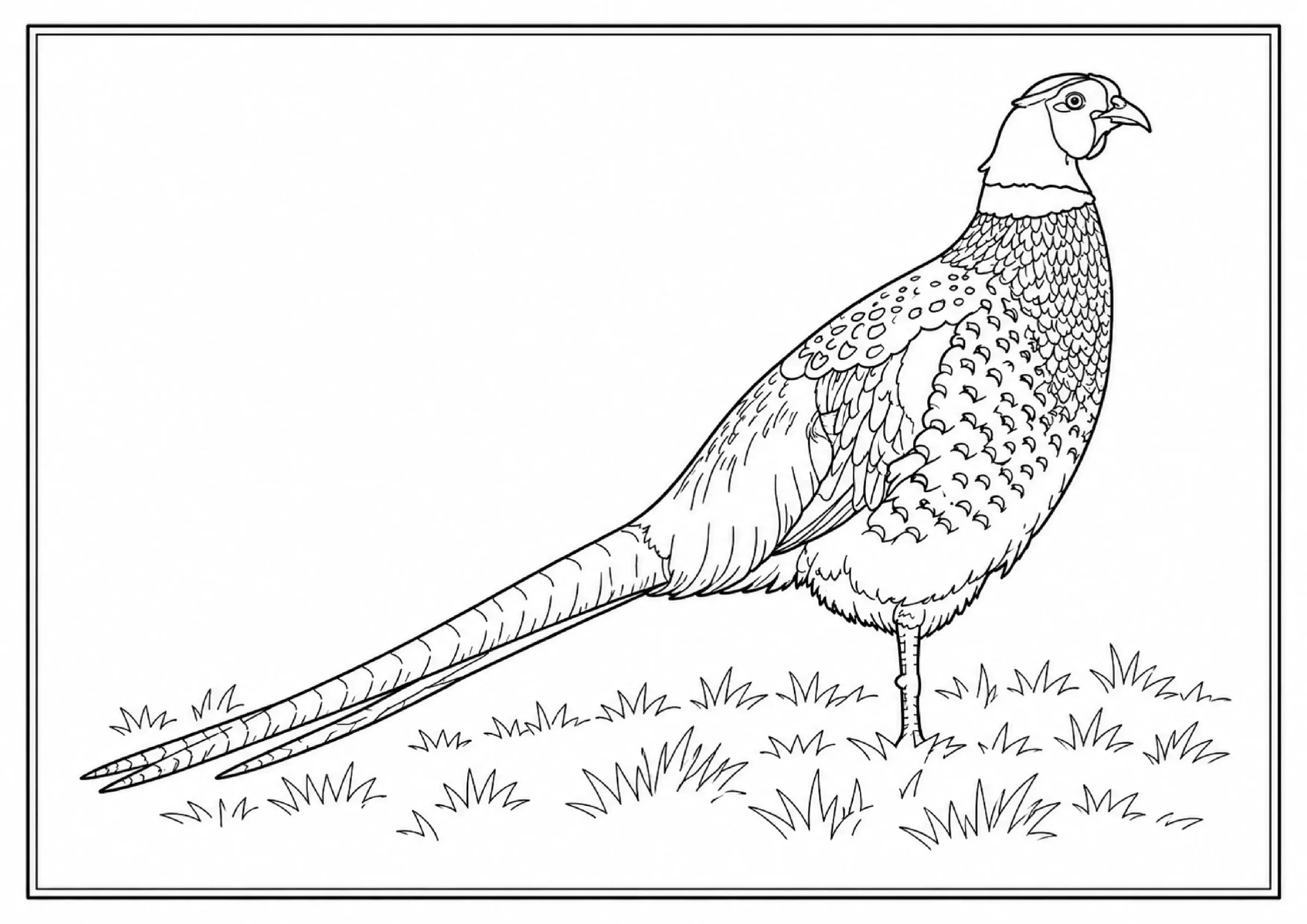
- Scientific name: Phasianus colchicus
- Group: Farmland Birds
This printable Common Pheasant coloring page is based on the bird’s long tail, rounded body, small head, and distinctive plumage.
Male Common Pheasants are especially colorful, with a metallic green head, red facial skin, rich chestnut body, and a very long barred tail. Females are much more subdued, with mottled brown plumage that helps them blend into grass and vegetation.
Use the natural color guide for a realistic result, or choose your own colors and create a more imaginative version.
Color guide
Adult male:
- Head: dark green with metallic blue and purple sheen
- Face: bright red bare skin around the eye
- Neck: glossy green, often with a white neck ring in many introduced populations
- Breast and body: rich chestnut, copper, and reddish brown
- Back and wings: brown, gold, black, and cream with intricate markings
- Tail: long, golden brown to olive-brown with dark bars
- Bill: pale horn or grayish
- Eyes: yellowish to amber
- Legs and feet: gray-brown
Adult female:
- Body: mottled brown, buff, and beige
- Back and wings: brown with darker spots and bars
- Underparts: pale brown or buff
- Tail: brown with darker markings
The female’s muted colors provide excellent camouflage while nesting.
How to recognize a Common Pheasant
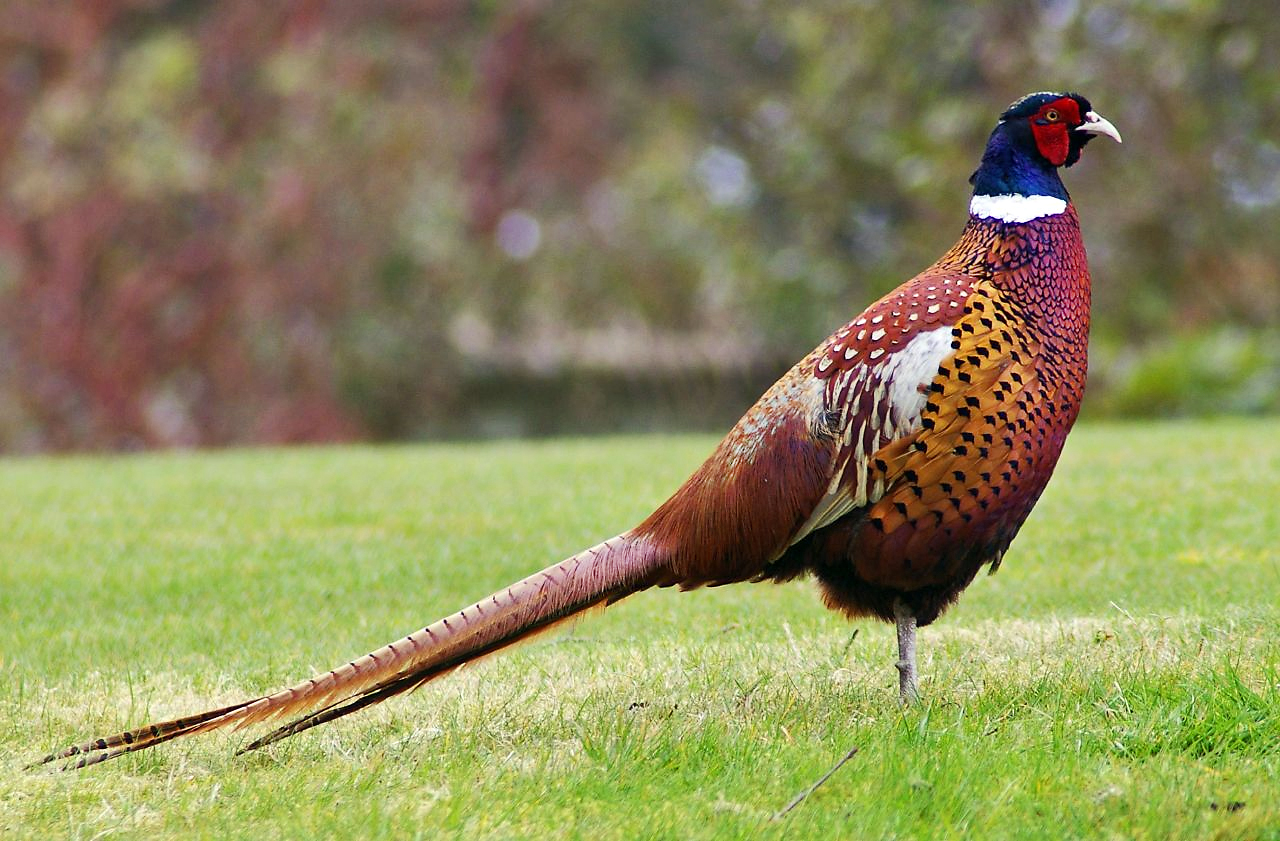
The Common Pheasant is a large ground-dwelling bird with a relatively small head and a very long pointed tail.
Males are easy to recognize because of their bright colors, red facial skin, glossy green head, and richly patterned body. Many males also have a white ring around the neck.
Females look very different. They are mostly brown and buff with dark mottling, making them much harder to spot in dry grass or farmland vegetation.
When disturbed, pheasants often burst suddenly from cover with loud wingbeats. Their flight is fast but usually relatively short before they land again.
Where it lives
Common Pheasants are strongly associated with farmland and open countryside.
They can be found in crop fields, grasslands, hedgerows, woodland edges, scrub, river valleys, and areas with a mixture of open ground and dense cover.
They often feed in fields but use hedges, bushes, tall grass, and woodland edges for shelter.
The species is native to large parts of Asia but has been introduced widely across Europe and many other parts of the world.
What it eats
Common Pheasants are omnivorous.
They eat seeds, grain, berries, shoots, leaves, and other plant material. They also feed on insects, beetles, caterpillars, spiders, worms, and other small invertebrates.
Young pheasants depend especially heavily on insects because they need protein for rapid growth.
Adults often forage on the ground, scratching through soil, leaves, and vegetation to find food.
Interesting facts
- The Common Pheasant belongs to the pheasant and partridge family, Phasianidae.
- Males and females look dramatically different, a good example of sexual dimorphism in birds.
- The male’s long tail can make up a large proportion of its total body length.
- Common Pheasants usually prefer running to escape danger, but if surprised they can explode into the air with powerful, noisy wingbeats.
- Males are territorial during the breeding season and may mate with several females.
- The species has been introduced to many countries for hunting and is now a familiar farmland bird across much of Europe.
- The scientific name Phasianus colchicus refers historically to the region of Colchis near the Black Sea, an area associated with pheasants in the ancient world.