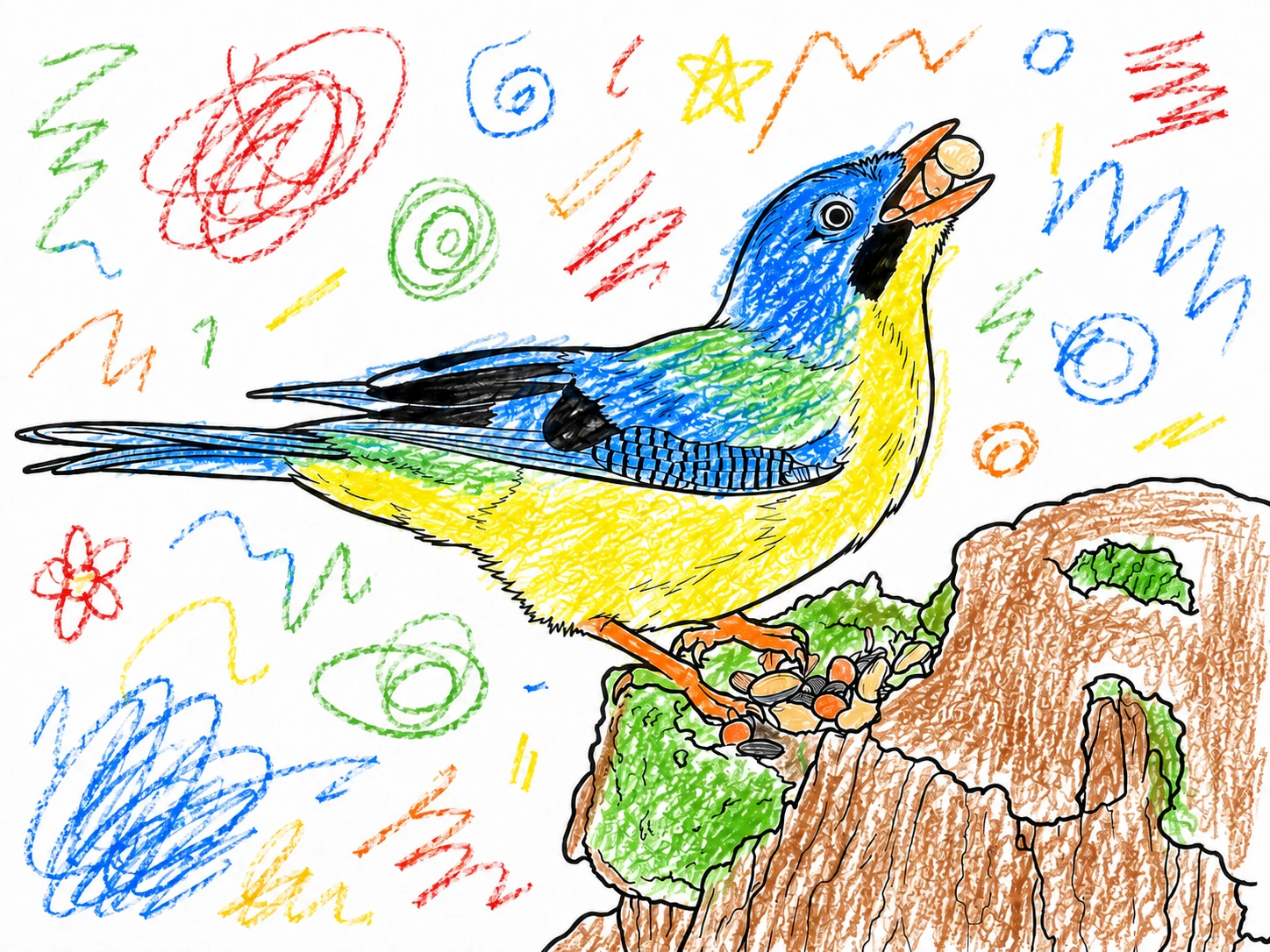
Color real birds, not generic cartoons. Our realistic bird coloring pages are based on real species and the features that make them recognizable in nature. Each illustration keeps the characteristic shape, bill, wings, tail, and important plumage markings of the bird while simplifying the image into clean linework that is enjoyable to color.
Choose a bird, print the page, follow its natural color guide, and discover the details birdwatchers use to identify it.
What makes a bird coloring page realistic?
A realistic coloring page does not need to show every feather. What matters is keeping the features that make the species recognizable.
A European Robin needs its rounded shape and orange-red face and breast. A Great Tit should have its black head, white cheeks, and dark stripe down the center of the belly. A Common Kestrel needs the slim falcon shape, pointed wings, and long tail that make it easy to recognize in flight.
The illustrations focus on these important details while leaving enough open space for comfortable coloring. This makes the pages suitable for children who are just learning about birds, while still giving older children and adults enough detail for more careful coloring.
Color birds as they really look
Real birds often have more colors than we notice at first. A European Green Woodpecker combines green plumage with a bright red crown and a yellow-green rump. A male Mallard has a glossy green head, chestnut breast, gray body, and bright orange feet. Other species may appear much simpler until you look closely.
A Rook can look completely black from a distance, but its feathers may show blue, violet, and green reflections in sunlight. A Greylag Goose contains subtle shades of gray, brown, cream, and pink. Following a natural color guide helps reveal these details.
You can also ignore the guide and invent your own colors. A realistic bird drawing can be a learning activity, a relaxing coloring page, or simply a place to experiment.
Learn bird identification while coloring
Coloring can encourage the same kind of careful observation used in bird identification.
Instead of seeing only “a small yellow bird” or “a brown duck,” you begin to notice the details that separate one species from another.
Look for features such as:
- head and face patterns
- wing bars and patches
- spots or stripes on the breast
- bill shape and color
- tail length
- leg color
- differences between males and females
Birdwatchers often call these features field marks.
Once you have spent time coloring them, they can become much easier to recognize when you see the real bird outdoors.
Compare similar birds
Some birds look very similar at first. Coloring two species side by side is a simple way to learn the differences.
Great Tit and Eurasian Blue Tit
Both birds have yellow underparts, but their heads are very different. The Great Tit has a black head, large white cheeks, and a strong black stripe running down the breast and belly. The Eurasian Blue Tit has a blue crown, white cheeks, and a dark stripe running through the eye. Once these markings become familiar, the two birds are much easier to tell apart.
Common Buzzard and Common Kestrel
Both are birds of prey, but their silhouettes are very different. A Common Buzzard is heavier, with broad rounded wings and a relatively short tail. A Common Kestrel is smaller and slimmer, with pointed wings and a longer tail. It is also famous for hovering in one place while searching for prey. Shape can sometimes be more useful than color when identifying birds in flight.
Common Wood Pigeon and Eurasian Collared Dove
The Common Wood Pigeon is a large, heavy pigeon with distinctive white patches on the neck and wings. The Eurasian Collared Dove is slimmer and paler, with a narrow black collar around the back of the neck. Coloring both birds makes the difference in body shape and markings much easier to remember.
Discover birds by habitat
Birds can also be explored by the places where they live.
Garden and Park Birds
These are some of the easiest birds to begin with because many can be seen close to home. European Robin, Great Tit, Eurasian Blue Tit, Common Blackbird, Common Starling, and other familiar species can often be found in gardens, parks, and around buildings.
Woodland Birds
Woodland birds include species that spend much of their time among trees, forest edges, and wooded parks. Woodpeckers, jays, and many other species have markings and body shapes adapted to life around trees.
Birds of Prey
Birds of prey are especially interesting to color because shape is such an important part of their identification. Look at wing width, tail length, body size, facial markings, and the pattern of the underside.
Waterbirds
Swans, ducks, geese, and other waterbirds often have strong differences in body shape, bill shape, and plumage. Because they can usually be watched for longer periods than small woodland birds, they are also excellent species for beginner birdwatchers.
Farmland Birds
Fields, meadows, hedgerows, and open countryside support many distinctive birds. Species such as the Common Pheasant and Northern Lapwing have very different shapes and colors, making them especially enjoyable to study through coloring.
Coastal Birds
Coastal birds can be found around beaches, cliffs, estuaries, harbors, and the sea. Look for differences in bill shape, leg color, wing patterns, and body size.
Realistic coloring does not have to be difficult
The word realistic can sound complicated, but a bird does not need perfect shading or individually drawn feathers to look convincing. Start with the largest areas.
Color the body first, then the wings, head, and tail. After that, add smaller details such as eye stripes, spots, wing patches, colored bills, or dark feather edges.
Younger children can use simple blocks of color.
Older children and adults can add shadows, feather texture, subtle color transitions, and small markings.
Both approaches work.
The goal is not perfect scientific accuracy. The goal is to notice what makes the bird different.
Bird coloring pages for kids
Realistic bird coloring pages can be a simple way to introduce children to nature. A child can learn the name of the bird, its main colors, where it lives, what it eats, and one or two features that help identify it.
Try asking simple questions while coloring.
- Which part of the bird is brightest?
- Is the bill long or short?
- Does the bird have spots or stripes?
- Would you expect to find it in a garden, woodland, or near water?
- What would you look for if you saw this bird outside?
A coloring page can quickly become a small nature lesson without feeling like homework.
Realistic bird coloring for adults
The same pages can also be used for slower and more detailed coloring. Colored pencils are especially useful for creating feather texture and layering several shades together. Instead of using a single brown, try mixing gray, ochre, cream, and darker brown. Instead of coloring black plumage with one pencil, add subtle blue, green, or violet highlights. Looking closely at real plumage can reveal surprisingly complex colors.
From coloring page to real bird
The most interesting part can happen after the coloring is finished. Take the page to a window, garden, park, lake, or woodland walk and look for birds. You may suddenly notice a white cheek patch, a long tail, a colored bill, or a particular wing pattern that you remember from the page. You may not find the exact species you colored, but you can still practice observation.
Is the bird larger or smaller? Does it have the same bill shape? What color is the breast? How does it move? Does it walk, hop, climb, swim, or hover?
This is how a coloring page can become a first step toward bird identification.
Choose a bird and start coloring
Browse the collection of realistic bird coloring pages and choose a species you would like to discover. Print the page, look at the natural colors, and start with the details that catch your attention.
Then keep the finished picture nearby.
The next time you see a bird outside, you may recognize something you first noticed while coloring.
Frequently Asked Questions
Are these coloring pages based on real bird species?
Yes. The pages represent real species and are designed around recognizable features such as body shape, plumage patterns, bills, wings, and tails.
Do I have to use the real bird colors?
No. You can follow the natural color guide for a realistic version or choose completely different colors.
Are realistic bird coloring pages suitable for kids?
Yes. Younger children can use simple colors, while older children can focus on markings, feather patterns, and identification features.
Can coloring help children learn bird identification?
Coloring encourages close observation. Spending time looking at field marks, body shape, colors, and patterns can make those features easier to remember later.
Where can I find the correct colors for each bird?
Each species page can include a Color Guide describing the bird’s main natural colors and important markings.