- Scientific name: Corvus frugilegus
- Group: Farmland Birds
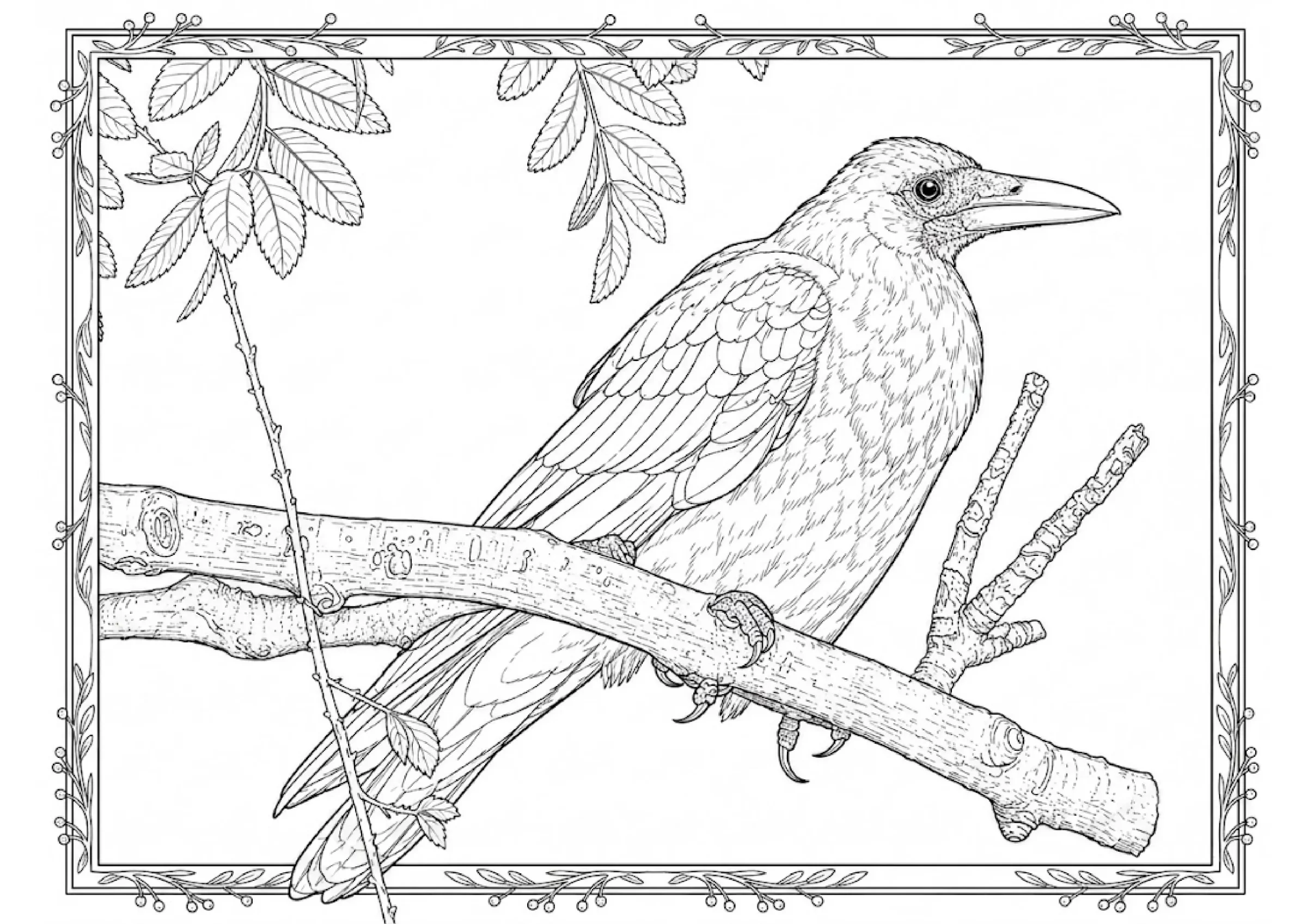
This printable Rook coloring page is inspired by the bird’s sturdy body, long pointed bill, strong legs, and glossy dark plumage. The clean outlines make it suitable for colored pencils, crayons, markers, or paint.
Use black, charcoal gray, blue, and purple tones to recreate the natural appearance of an adult Rook. Although the bird looks black from a distance, its feathers can show beautiful blue, violet, and green reflections in bright light.
Color guide
- Head and body: glossy black
- Wings: black with blue, purple, or green sheen
- Tail: black
- Bill: gray-black
- Bare skin around the base of the bill: pale gray or whitish
- Eyes: dark brown or black
- Legs and feet: black or dark gray
Young Rooks look more like Carrion Crows because they still have feathers around the base of the bill. The pale bare skin develops as they mature.
How to recognize a Rook
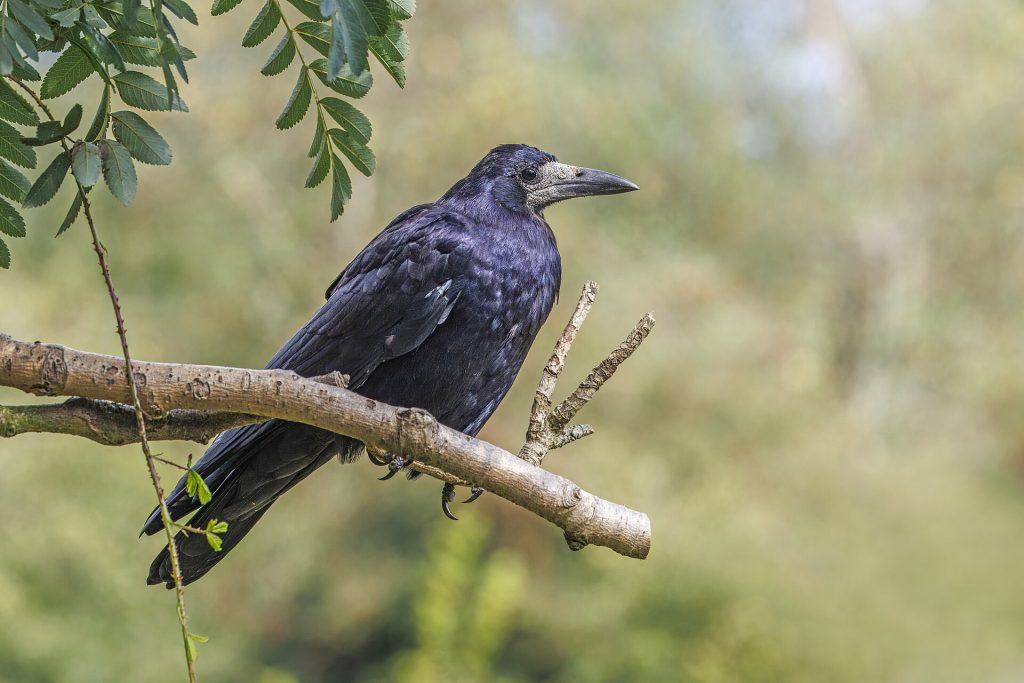
The Rook is a large member of the crow family with entirely dark plumage, a relatively long pointed bill, and a slightly peaked head. Adult birds are especially recognizable by the pale, bare skin around the base of the bill.
Compared with a Carrion Crow, a Rook often looks slimmer and has a more pointed bill. Its feathers can appear slightly loose or shaggy around the legs, giving the bird a distinctive appearance when standing on the ground.
Rooks are highly social. They are often seen in flocks, especially on farmland, and frequently nest together in large colonies known as rookeries.
Where it lives
Rooks are widespread across much of Europe and parts of Asia. They are especially associated with farmland, pastures, meadows, open countryside, and villages with groups of tall mature trees.
They usually feed in open fields but prefer to nest high in trees. Colonies may contain dozens or even hundreds of nests, often reused and repaired from year to year.
Rooks can also be found in parks, roadside fields, and around towns where suitable feeding areas are nearby.
What it eats
Rooks are omnivorous and eat a wide variety of foods. Their diet includes earthworms, beetles, insect larvae, seeds, grain, roots, fruit, and other plant material.
They often walk across ploughed or grassy fields, probing the soil with their long bills for hidden invertebrates. They may also follow farm machinery, taking advantage of insects and worms exposed by freshly disturbed ground.
Rooks sometimes eat carrion and food scraps, especially when other food is difficult to find.
Interesting facts
- Rooks belong to the crow family, Corvidae, along with crows, ravens, jays, and magpies.
- Large nesting colonies are called rookeries, and some traditional rookeries have been occupied for many generations.
- Adult Rooks have a distinctive patch of bare pale skin around the base of the bill, while young birds initially have feathers in this area.
- Their black feathers are not simply black. In sunlight, they can show metallic blue, purple, and green highlights.
- Rooks are intelligent and social birds that often feed and roost together in large groups.
- Outside the breeding season, they may gather with Jackdaws in very large communal roosts.