
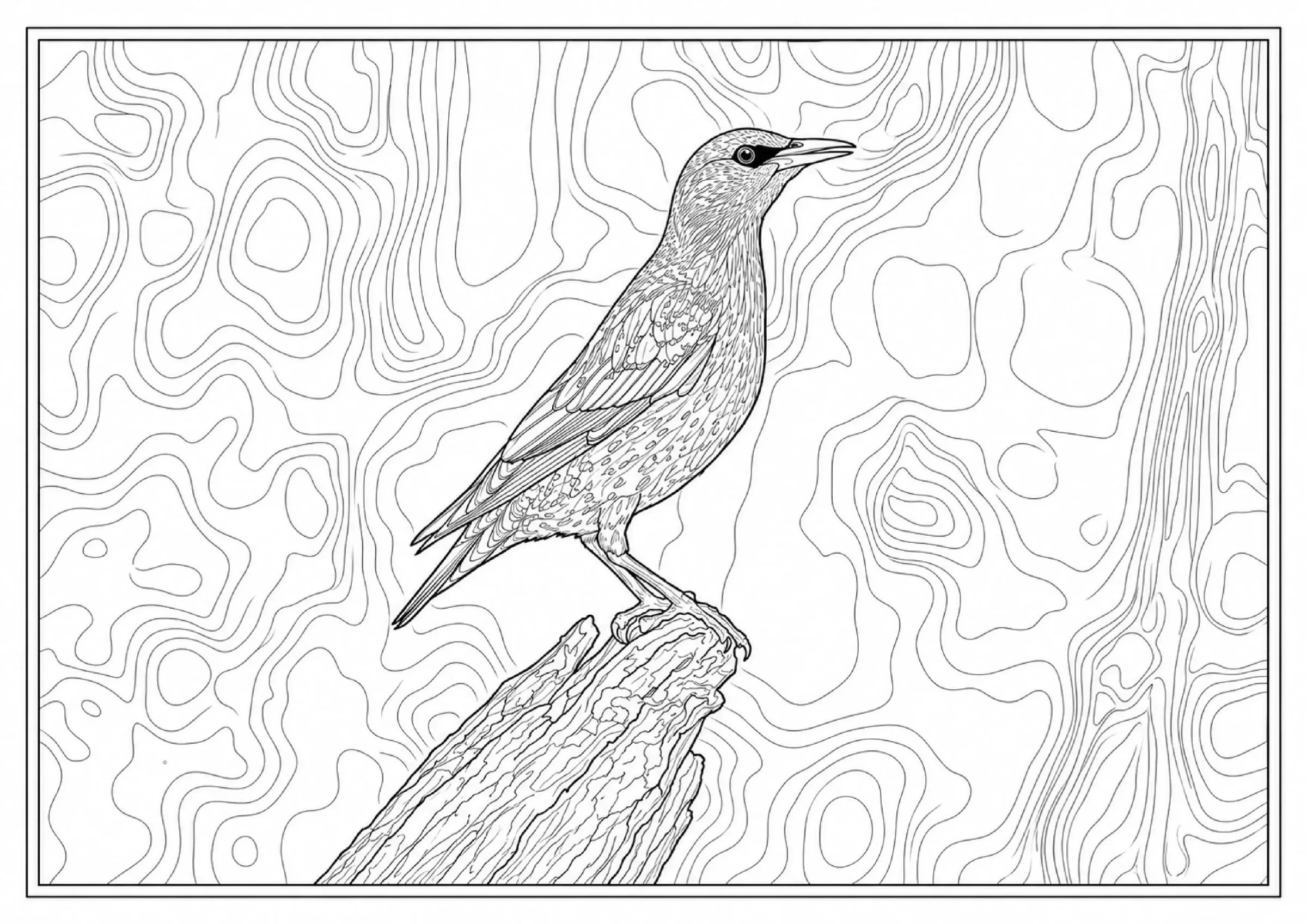
- Scientific name: Sturnus vulgaris
- Group: Garden Birds
This printable Common Starling coloring page is inspired by the bird’s compact body, pointed bill, short tail, and glossy plumage. The clean outlines make it suitable for colored pencils, crayons, markers, or paint.
Use black, green, purple, brown, and white to recreate the bird’s natural appearance. Common Starlings are especially fun to color because their dark feathers can shine with metallic green and violet tones, while pale spots add extra detail.
Color guide
- Head and body: glossy black
- Neck and breast: black with green and purple iridescence
- Back and wings: dark brown-black with metallic highlights
- Feather spots: white or pale cream
- Tail: dark brown or black
- Bill in breeding season: yellow
- Bill outside breeding season: dark gray or black
- Eyes: dark brown
- Legs and feet: reddish brown or pinkish brown
Young birds are much duller than adults and are mostly plain gray-brown.
How to recognize a Common Starling
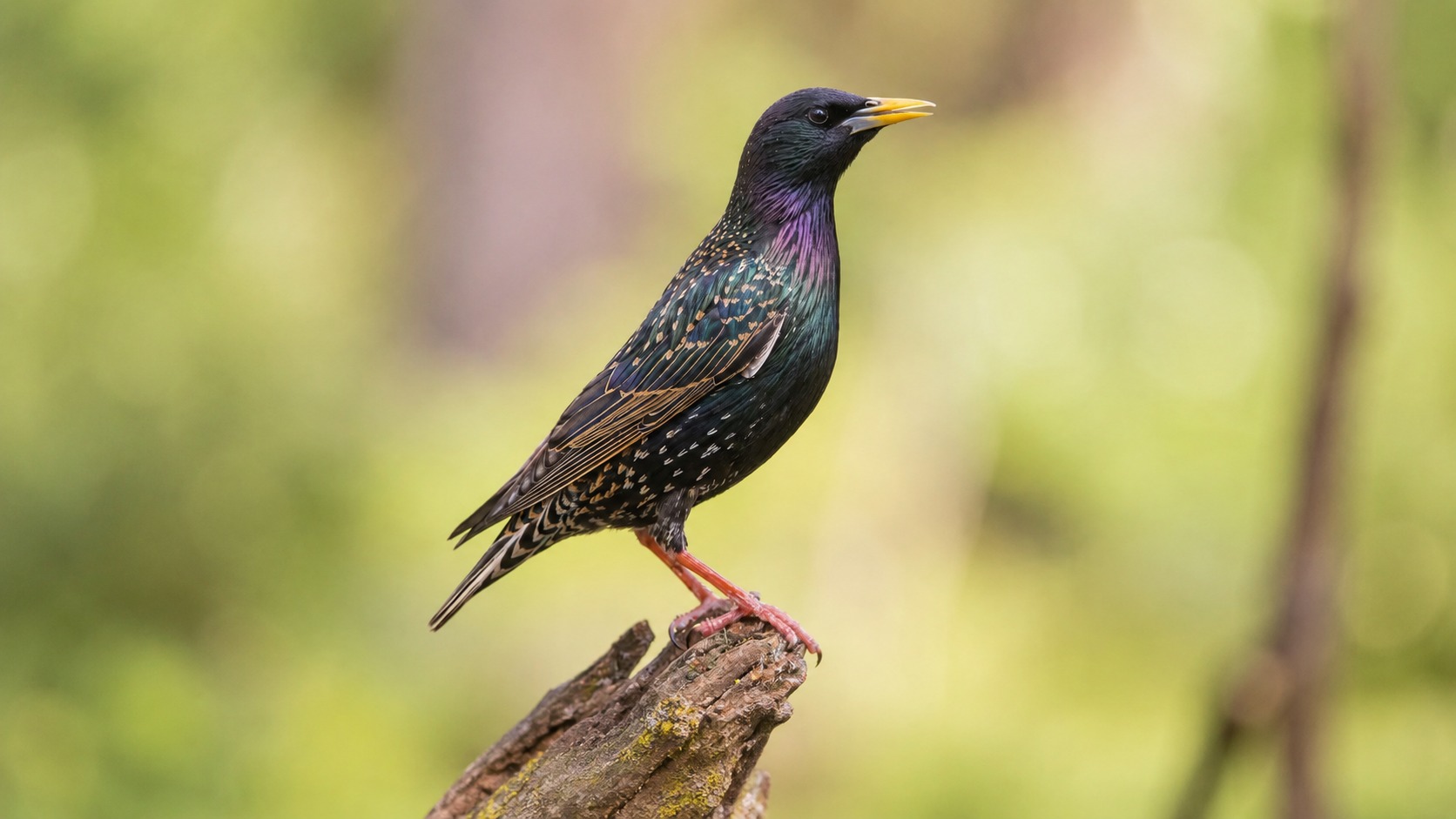
The Common Starling is a medium-sized songbird with a compact body, triangular pointed wings, a short tail, and a long sharp bill.
Adults look almost black from a distance, but in good light their feathers show glossy green and purple reflections. Outside the breeding season, the plumage is covered with many small pale spots, giving the bird a speckled appearance.
Starlings often walk rather than hop when feeding on the ground. In flight, their pointed wings and short tail create a distinctive shape.
Where it lives
Common Starlings are found in farmland, gardens, parks, towns, villages, grasslands, and open woodland. They adapt very well to human environments and often nest in holes in buildings, trees, and nest boxes.
They are widespread across Europe and parts of western Asia and have also been introduced to several other regions.
Outside the breeding season, starlings often gather in large flocks to feed and roost together.
What it eats
Common Starlings are omnivorous. They eat insects, beetles, larvae, spiders, earthworms, fruit, berries, seeds, and other plant material.
They frequently feed on lawns and fields, probing the soil with their pointed bills to find hidden invertebrates.
In towns and gardens, they may also take food from bird feeders and other human-associated sources.
Interesting facts
- Common Starlings are famous for forming huge synchronized flocks known as murmurations.
- Their dark plumage is highly iridescent and can appear green, purple, blue, or bronze depending on the angle of the light.
- Starlings are excellent mimics and can imitate the calls of other birds as well as some mechanical and environmental sounds.
- Their breeding plumage looks less spotted because the pale tips of the feathers gradually wear away.
- They often nest in cavities and will readily use holes in trees, walls, roofs, and nest boxes.
- Although they can gather in enormous groups, each bird still reacts quickly to its neighbors, helping the flock change direction almost instantly.