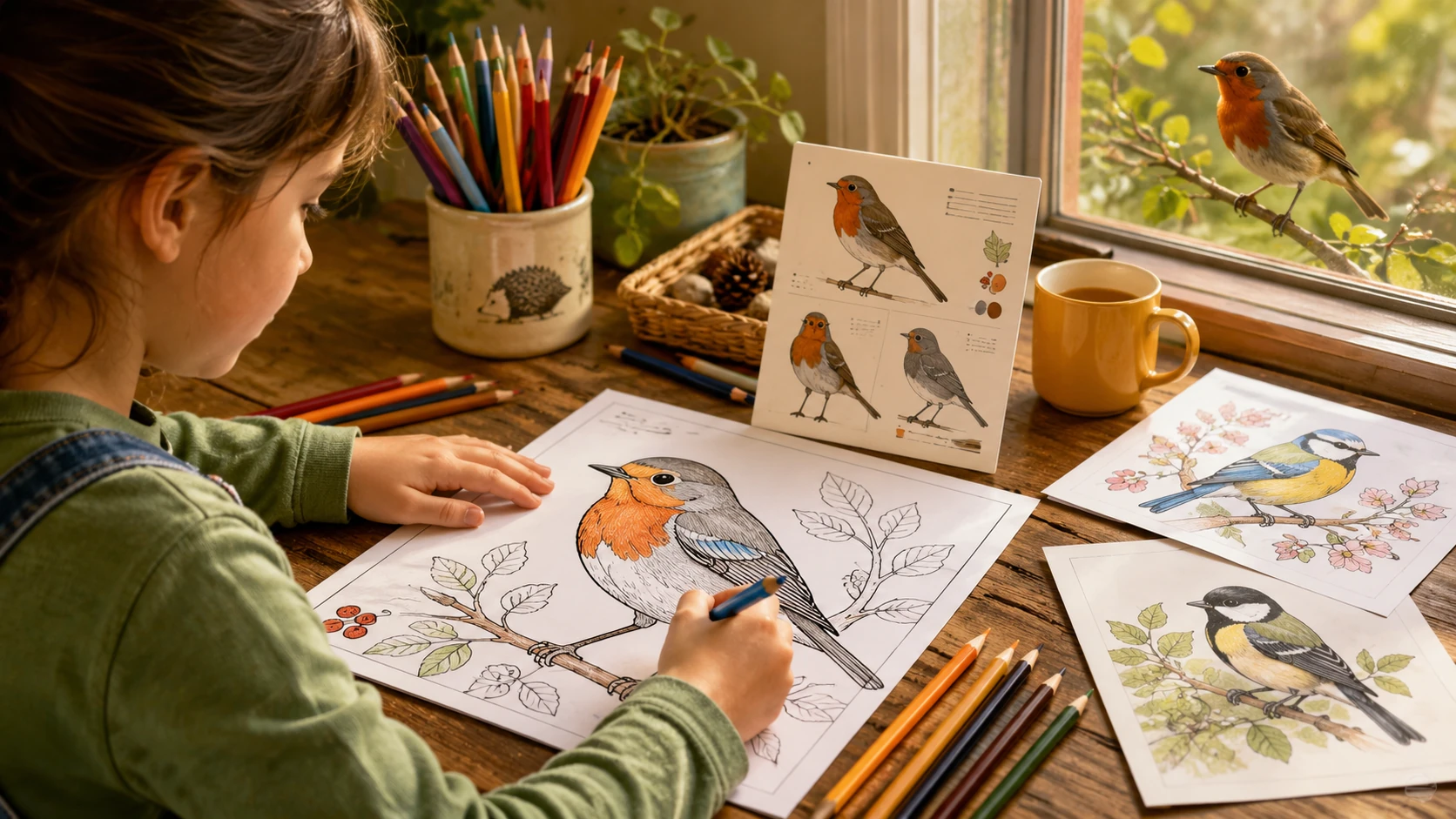
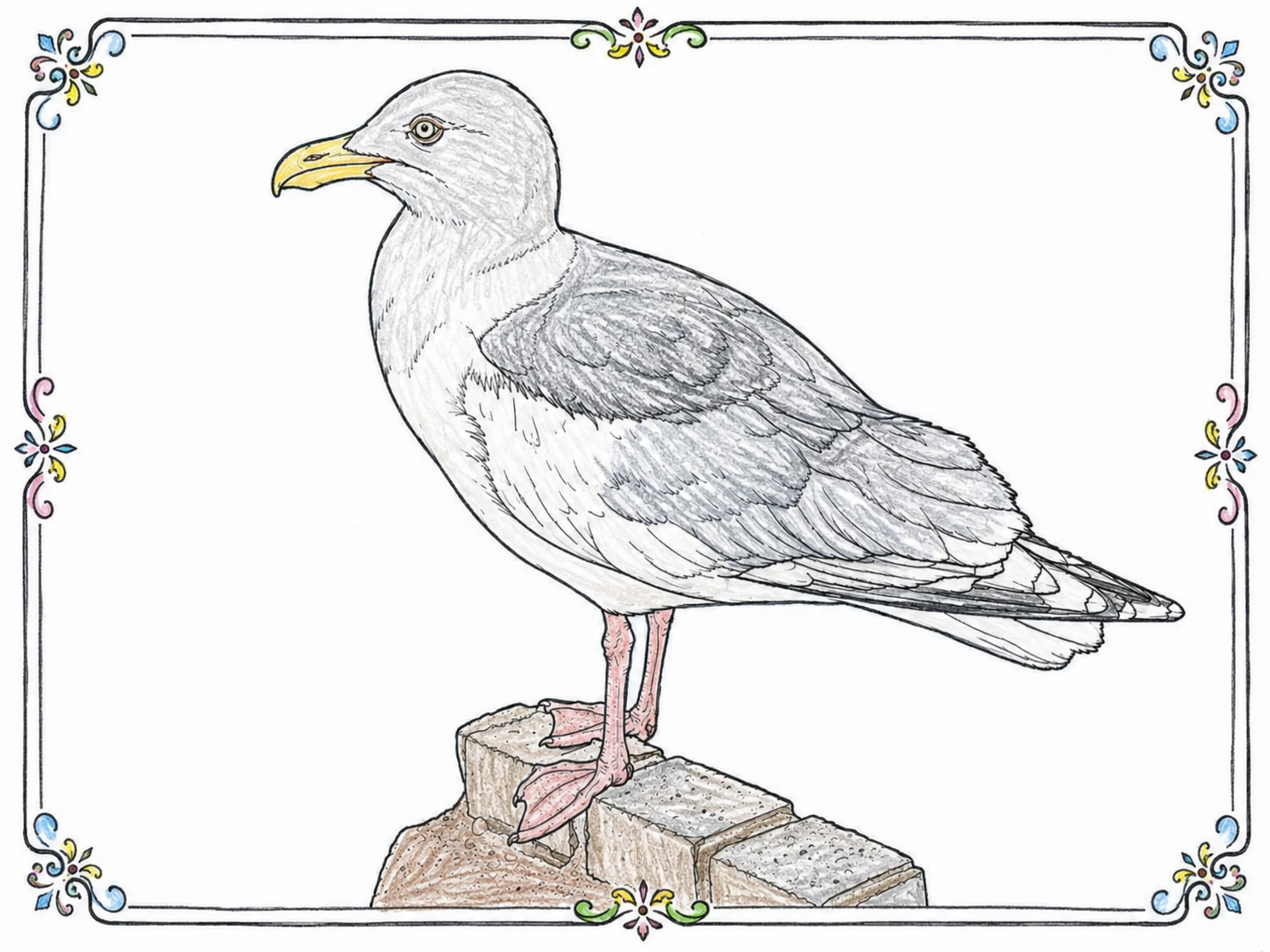
A bird coloring page can be much more than a quiet creative activity. With a few simple questions and observations, it can become a small nature lesson that helps children notice shapes, colors, behavior, and the differences between real bird species.
The best part is that you do not need special equipment or a long lesson plan. A printable bird page, a few pencils, and a little curiosity are enough.
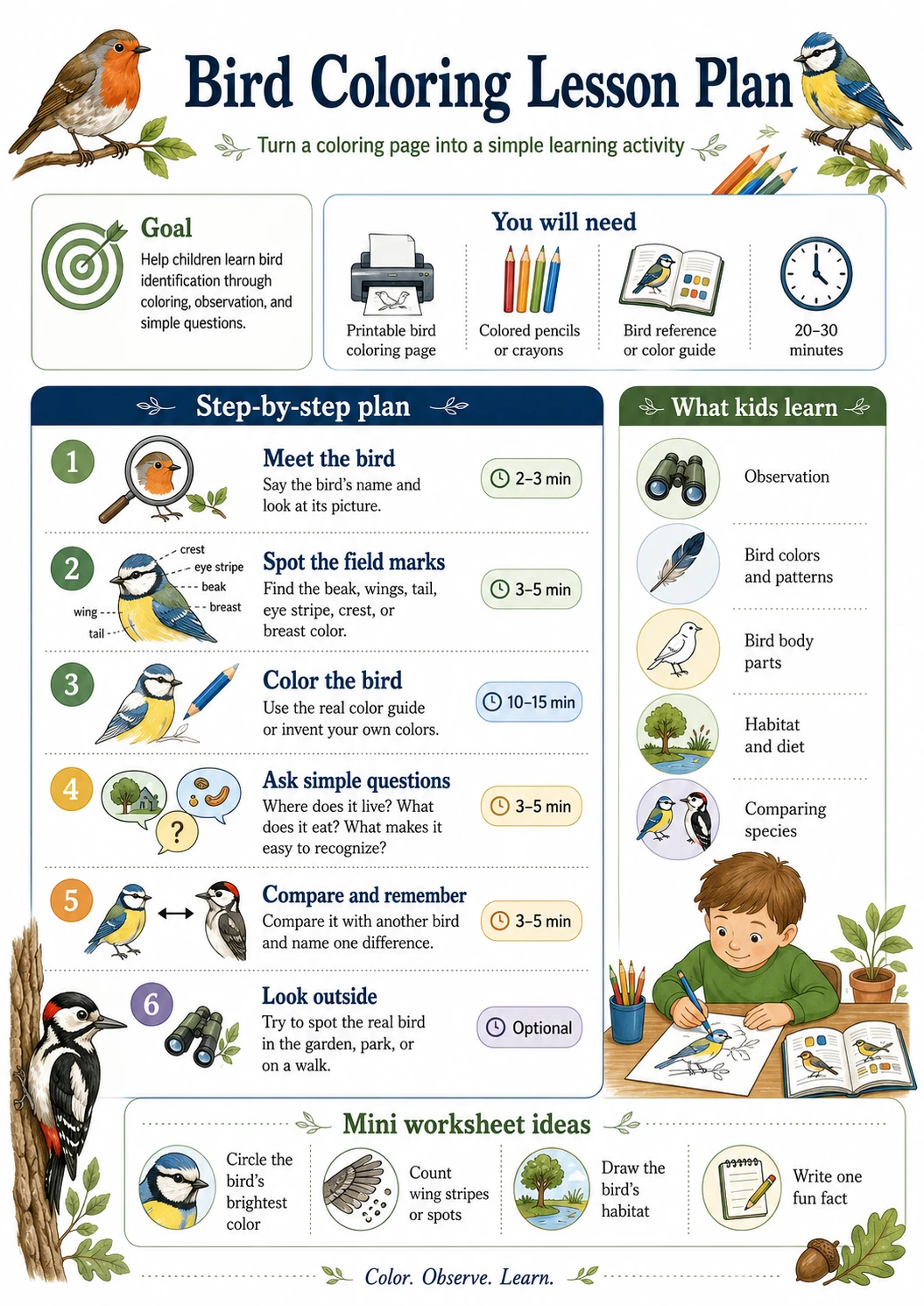
Start with the bird’s name
Before coloring, tell the child which bird is on the page.
Say the common name first, then show the scientific name if it is included. There is no need to memorize it. The goal is simply to introduce the idea that every bird species has its own identity.
You can also ask:
- Have you seen this bird before?
- Where do you think it lives?
- Is it a small bird or a large one?
Even a guess makes the activity more interactive.
Look for the bird’s field marks
Before choosing colors, spend a minute looking at the illustration.
Ask the child to find the features that make this bird recognizable. Birdwatchers often call these features field marks.
They may include a colored breast, an eye stripe, wing bars, spots, a crest, a long tail, or a distinctive bill.
For example, a European Robin has an orange-red face and breast, while a Great Tit has a black head, white cheeks, and a yellow underside.
The goal is not to memorize every detail. It is to learn to look carefully.
Use the color guide as a puzzle
Instead of simply giving the child the correct colors, turn the color guide into a small challenge.
Ask:
- Which part of the bird should be colored first?
- Where does this color appear?
- Are the wings the same color as the body?
- Is the tail lighter or darker?
- Does the bird have more than one shade of brown or gray?
This helps children understand that real birds are rarely made from one simple color.
Count the colors
For younger children, turn the page into a counting activity.
- How many main colors can you find on the bird?
- How many white patches are there?
- How many dark stripes can you see?
- How many colors are on the wing?
This combines observation with simple number practice.
Learn the parts of a bird
A coloring page is also a simple introduction to bird anatomy.
Point out parts such as the bill, crown, throat, breast, wings, tail, legs, and feet.
You do not need to introduce all the terms at once. Choose two or three for each bird.
For example:
- Find the bird’s bill.
- Color the breast.
- Which feathers make up the tail?
After several pages, children may start using these words naturally.
Ask what the bill can tell you
The shape of a bird’s bill often gives clues about what it eats.
A short, strong bill can be useful for cracking seeds. A thin pointed bill can help catch insects. A hooked bill belongs to a bird adapted for tearing food.
Ask the child to look at the bill and guess:
- What might this bird eat?
- Would it be good at catching insects?
- Could it open seeds?
Then compare the guess with the bird’s real diet.
Match the bird to its habitat
Talk about where the species lives. Does it prefer woodland, gardens, farmland, wetlands, or the coast?
You can draw a simple background around the bird or ask the child to add one.
A woodland bird might get trees and leaves. A waterbird could have reeds and a pond. A farmland bird might be surrounded by grass and fields.
Now the coloring page becomes a picture of the bird in its environment.
Compare two birds
Once the child has colored several species, place two pages next to each other.
Comparison is one of the easiest ways to learn bird identification.
Ask:
- Which bird is larger?
- Which has the longer tail?
- Do they have the same bill shape?
- Which one has brighter colors?
- What marking would help you tell them apart quickly?
Try comparing birds that look somewhat similar, such as a Great Tit and Eurasian Blue Tit, or a Common Wood Pigeon and Eurasian Collared Dove.
Add a bird fact challenge
Choose one interesting fact about the species and turn it into a question.
For example:
- Which bird can climb tree trunks?
- Which bird spends a lot of time searching for ants?
- Which bird is famous for laying its eggs in another bird’s nest?
- Which bird can form enormous flocks in the sky?
Children are often more likely to remember one surprising fact than a long list of information.
Make an observation card
After the coloring page is finished, create a tiny bird observation card.
Write down:
- Bird name
- Main colors
- One important field mark
- Habitat
- Favorite food
- One interesting fact
The child can keep these cards with the finished coloring pages and gradually build a personal bird collection.
Take the activity outside
The final step is to connect the coloring page with the real world.
Put the finished page near a window, take it into the garden, or bring it on a walk.
Look for birds and compare them with the drawing.
You may not find the exact species, and that is fine. Ask the child to notice the same kinds of details:
- What color is the breast?
- How long is the tail?
- What shape is the bill?
- Does the bird walk, hop, climb, or swim?
This turns coloring into observation.
Let children use imaginary colors too
Learning about real bird colors does not mean every picture has to be realistic. One useful approach is to color one bird using its natural plumage and another using completely imaginary colors.
The first page teaches identification. The second encourages creativity.
You can even ask the child which parts they changed and which field marks they kept.
Create a bird coloring journal
Instead of treating each coloring page as a separate activity, collect them in a folder or notebook. Add the date, bird name, a short fact, and perhaps a note about whether the child has seen the species in real life.
Over time, the folder becomes a simple bird journal. Children can look back through it, compare species, and see how many birds they have learned.
From coloring to curiosity
A bird coloring page does not need to become a formal lesson. A few questions are enough. What color is it? What makes it different? Where does it live? What does it eat? Could we see one outside?
When children begin asking these questions on their own, the coloring page has already done something important: it has taught them to look more closely at nature.