Bird identification can feel difficult at first. Many birds are small, fast, and surprisingly similar to one another. A child may notice that two species are both brown, or both have yellow on the breast, without yet seeing the smaller details that make each bird unique.
Coloring slows that process down.
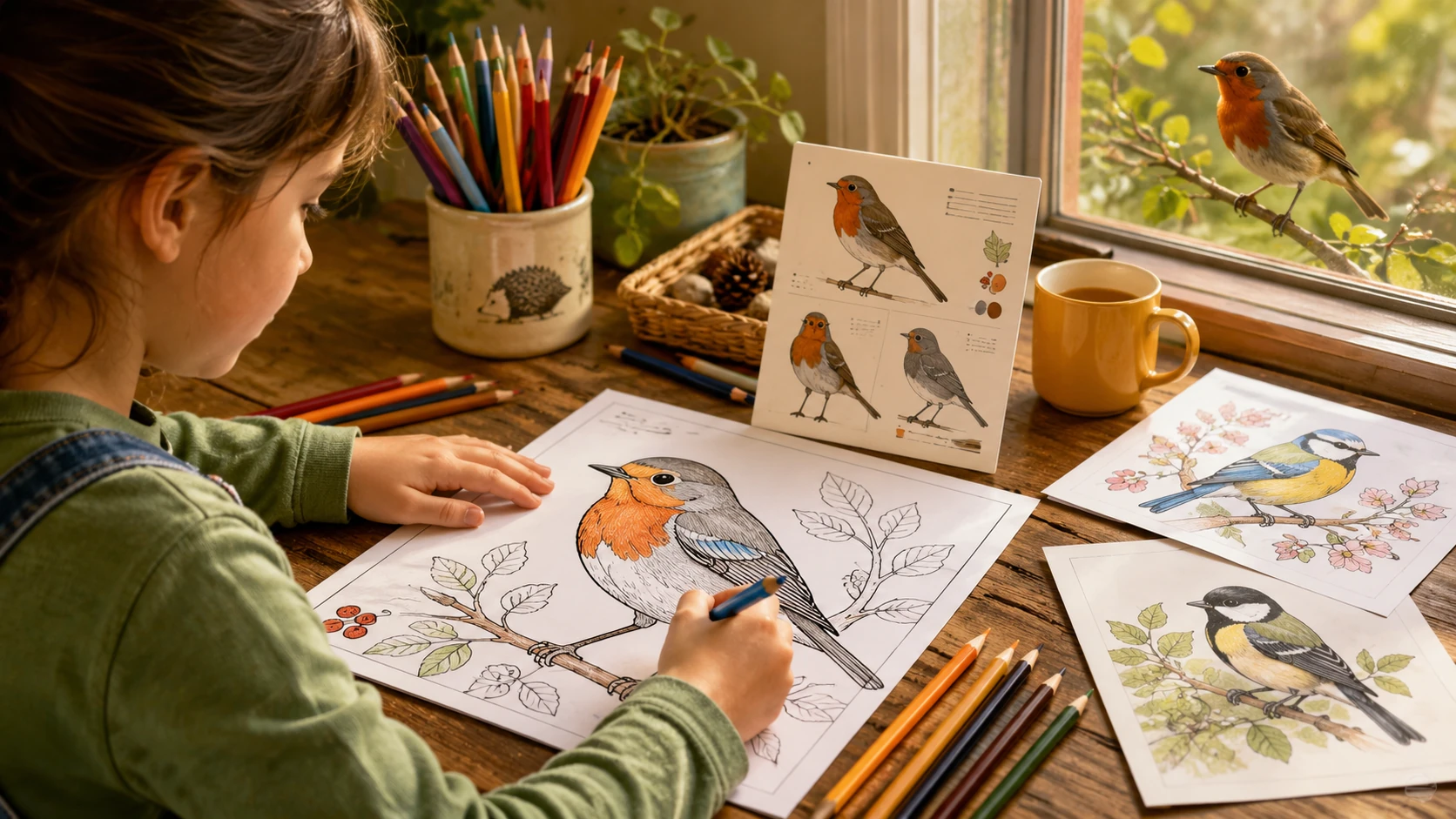
When children color a bird, they spend time looking at its shape, markings, and colors. Instead of seeing “a small bird,” they begin to notice a dark stripe through the eye, a white patch on the wing, a red crown, or the shape of the bill. These details are known as field marks, and they are some of the most useful clues for identifying birds in the wild.
Coloring encourages careful observation
A photograph can be looked at in a few seconds. A coloring page asks for more attention.
Before choosing a pencil, a child may need to decide where the yellow breast ends, which feathers are black, or whether the tail has one color or several. That simple act of looking closely helps turn visual details into something memorable.
For example, while coloring a Great Tit, a child may notice its black head, white cheeks, yellow belly, and dark stripe down the center of the breast. Later, seeing the same combination at a feeder can make identification much easier.
It makes field marks easier to remember
Birdwatchers often identify species using a small number of distinctive features rather than trying to remember the entire bird.
These can include:
- the color of the crown or throat
- stripes around the eye
- spots or bars on the wings
- the shape and length of the tail
- the size and shape of the bill
- patches of color on the breast, neck, or rump
Coloring gives children a reason to pay attention to each of these areas separately.
A Eurasian Blue Tit, for instance, is not simply “blue and yellow.” Its blue crown, white cheeks, dark eye stripe, greenish back, and yellow belly together create the pattern that identifies the species.
Drawing and coloring create stronger visual memories
Active tasks are often easier to remember than passive ones. Coloring requires a child to make repeated decisions about where each color belongs, so the bird’s features are revisited again and again.
The goal does not have to be perfect accuracy. Even comparing a coloring page with a reference image can encourage children to ask useful questions:
Why is this patch white?
Does the male look different from the female?
Why are the wings darker than the body?
Does this bird always have a red breast?
Those questions are the beginning of real observation.
It helps children compare similar birds
Some of the best identification skills come from comparing two species.
A Great Tit and Eurasian Blue Tit may appear similar at first, but coloring both makes their differences much clearer. One has a black head and strong black belly stripe, while the other has a blue cap and a more delicate face pattern.
The same approach works with thrushes, pigeons, gulls, woodpeckers, and birds of prey. Once children learn to look for differences rather than simply overall color, identifying unfamiliar birds becomes much easier.
Coloring introduces bird anatomy naturally
Bird identification is not only about color.
A coloring page also gives children time to notice the shape of the bird itself. A sparrowhawk has a long tail and relatively short wings. A woodpecker has a strong pointed bill and stiff tail. A lapwing has a crest and broad rounded wings.
Without turning the activity into a formal anatomy lesson, children begin to recognize features such as:
beak shape, wing shape, tail length, leg length, posture, and body size.
These structural clues are especially useful when colors are difficult to see.
It can connect indoor learning with outdoor observation
The most useful step comes after the picture is finished.
Take the coloring page outside, place it near a window, or bring it on a walk. Ask the child to look for the same bird—or another species with similar features.
A simple activity might be:
Color a European Robin.
Look at its orange-red face and breast.
Go outside and watch for small birds.
If a robin appears, compare the real bird with the coloring page.
This turns the page into a simple field guide created by the child.
Natural colors are a guide, not a rule
Learning does not mean every bird has to be colored perfectly.
Children can first use a natural color guide to understand what the real species looks like and then make another version using completely imaginary colors. A purple robin is still useful if the child remembers where the robin’s real orange breast would be.
The important part is knowing which features belong to the real bird.
Creativity and observation can work together.
Start with common birds
Children are more likely to remember birds they can actually encounter.
Good species to begin with include familiar garden and park birds such as:
- European Robin
- Great Tit
- Eurasian Blue Tit
- Common Blackbird
- Song Thrush
- Common Wood Pigeon
- Eurasian Collared Dove
Once these become familiar, children can move on to woodland birds, waterbirds, birds of prey, and less common species.
From coloring page to birdwatcher
A coloring page is a simple activity, but it can teach an important habit: look closely.
The more children notice the patterns, shapes, and small differences between birds, the easier identification becomes. Eventually, a black head, blue crown, spotted breast, white wing patch, or forked tail can become an immediate clue.
That is the idea behind Birds to Color: color the bird, notice the details, and then see if you can recognize it outside.