
- Scientific name: Oriolus oriolus
- Group: Woodland Birds
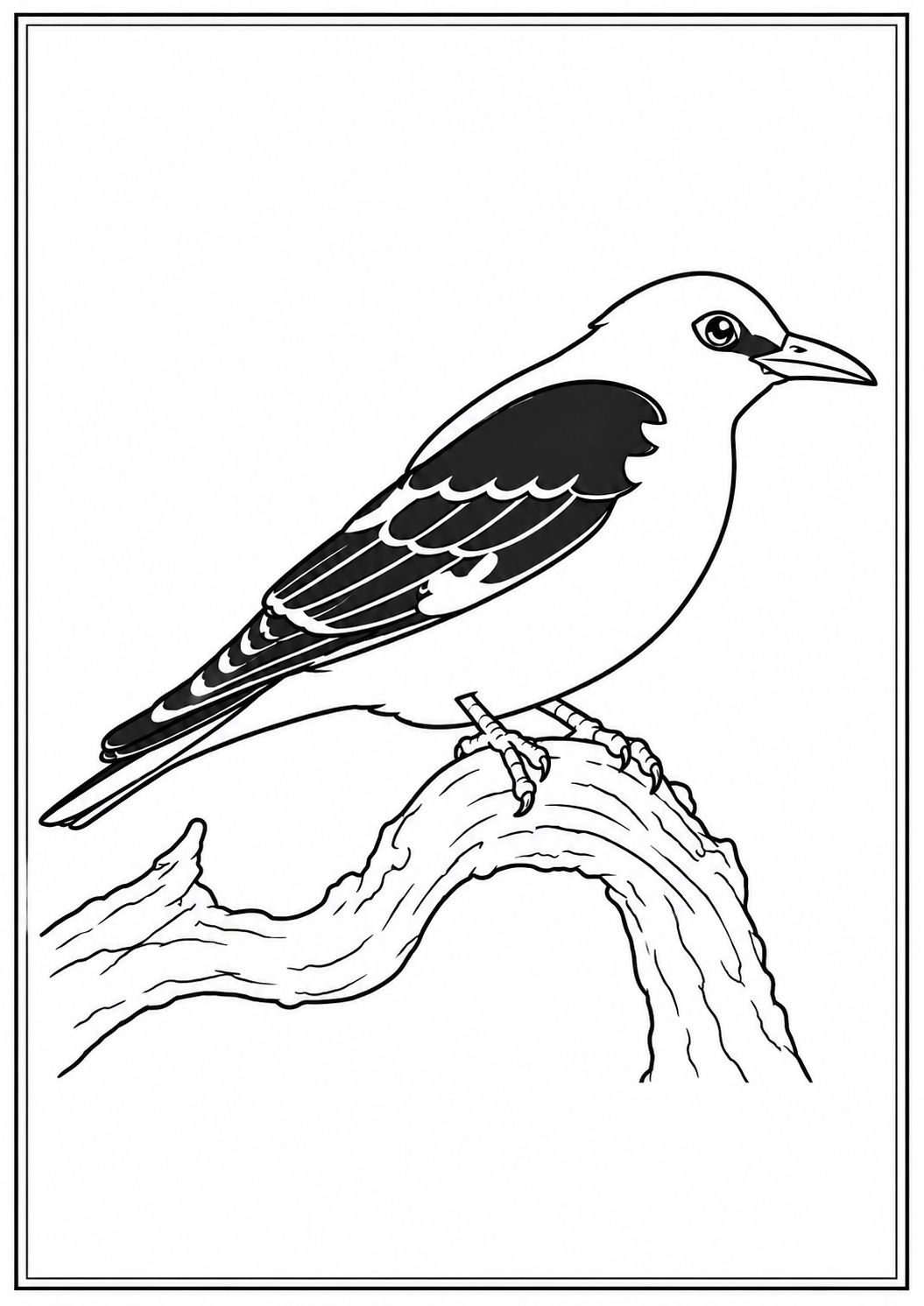
Download and print this Eurasian Golden Oriole coloring page, inspired by the real bird’s elegant shape and striking plumage. The illustration shows an oriole perched on a curved branch, with clearly defined wings, a long tail, a pointed bill, and the distinctive dark marking around the eye.
Color it using the bright yellow-and-black plumage of an adult male as your guide, try the softer greenish tones of a female, or invent an entirely new color pattern of your own.
About this coloring page
This printable Eurasian Golden Oriole illustration turns the bird’s most recognizable features into bold, clean linework. The broad wing panels, layered flight feathers, eye stripe, pointed bill, and long tail are separated into clear areas that are easy to fill with pencils, crayons, markers, or paint.
The bird is shown in side view, making it easy to notice how the dark wing contrasts with the lighter body. The branch also offers space for natural bark colors, shading, or imaginative patterns.
Download the print-ready PDF and use the bird’s natural plumage as a reference—or make your oriole as colorful as you like.
Color guide
Adult male
- Body and head: bright golden yellow
- Wings: black with yellow markings
- Tail: mostly black with yellow outer areas
- Eye stripe: black
- Bill: pinkish red or reddish brown
- Legs and feet: gray-blue or dark gray
- Eye: dark brown or black
Female or young bird
- Body: yellow-green or olive-green
- Underparts: paler, sometimes with fine dark streaks
- Wings: brownish or dark olive
- Bill: muted pink or reddish brown
- Legs and feet: gray
How to recognize a Eurasian Golden Oriole
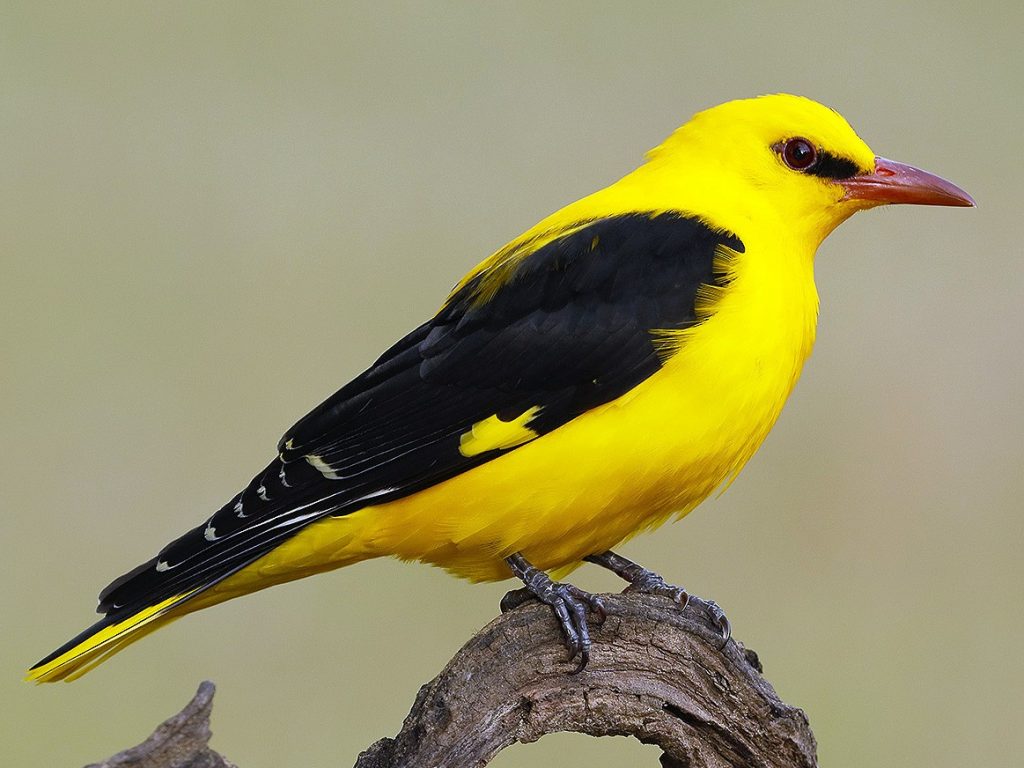
The Eurasian Golden Oriole is a medium-sized songbird with a streamlined body, a fairly long tail, and a strong, pointed bill. An adult male is difficult to confuse with most European birds: its body is brilliant golden yellow, while the wings and central parts of the tail are black.
Females and young birds are less brightly colored. They are usually greenish yellow or olive above, with paler underparts that may show fine streaking. Both sexes have a strong bill and an elongated shape that can sometimes be seen as the bird moves between branches.
Despite its bright plumage, the oriole can be surprisingly difficult to see. It often remains high among dense leaves, so its rich, fluting song may reveal its presence before the bird itself becomes visible.
Where it lives
Eurasian Golden Orioles breed in Europe and western parts of Asia. They favor mature deciduous woodland, open forests, river valleys, parks, orchards, and other landscapes with tall, leafy trees.
During the breeding season, they spend much of their time in the upper canopy. In autumn they migrate south, with many birds spending the non-breeding season in sub-Saharan Africa.
Look and listen for them in places with poplars, oaks, willows, and other broad-leaved trees. Even where they are present, their habit of hiding among foliage can make them easier to hear than to observe.
What it eats
Eurasian Golden Orioles feed on insects and fruit. They search through foliage for caterpillars, beetles, and other invertebrates, and they also eat berries and soft fruits when these are available.
Their strong bill helps them pick food from leaves, branches, and fruiting trees. Because they often feed high in the canopy, much of this activity can go unnoticed from the ground.
Interesting facts
- The Eurasian Golden Oriole belongs to the Old World oriole family, Oriolidae.
- Its scientific name, Oriolus oriolus, repeats the genus name as the species name.
- The male’s bright yellow plumage may seem conspicuous, but it can blend surprisingly well with sunlit leaves.
- Golden Orioles often remain hidden near the tops of trees and are frequently detected by their voice.
- The species is strongly migratory, breeding across parts of Europe and western Asia before moving to Africa for the non-breeding season.